


By Victoria Musa
For decades, Nigeria’s education system has been shaped by an overwhelming preference for university degrees, while technical and vocational education occupied the margins. The result is a familiar paradox: universities continue to produce thousands of graduates each year, yet industries struggle to find skilled technicians, artisans and technologists. Graduate unemployment remains high, the skills gap continues to widen, and the country still depends on foreign expertise for many specialised technical roles.
As Nigeria seeks to diversify its economy, expand local manufacturing and create sustainable employment, this imbalance can no longer be ignored. Technical and Vocational Education and Training (TVET) has emerged as one of the country’s most promising pathways to inclusive economic growth, with the National Business and Technical Examinations Board (NABTEB) playing an increasingly strategic role.
The Federal Government’s renewed focus on TVET marks one of the most significant shifts in education policy in recent years. Measures such as tuition-free education in Federal Technical Colleges, monthly stipends for students, industry-based training incentives and start-up support for graduates signal a deliberate effort to elevate skills acquisition alongside academic achievement. The objective is clear: produce a workforce equipped not only with certificates but with competencies that meet the needs of a modern economy.
At the centre of this transition is NABTEB, led by its Registrar and Chief Executive Officer, Dr. Mohammed Mohammed Aminu. Since assuming office, he has pursued reforms aimed at strengthening the Board’s institutional capacity while reinforcing the relevance of technical education to national development.


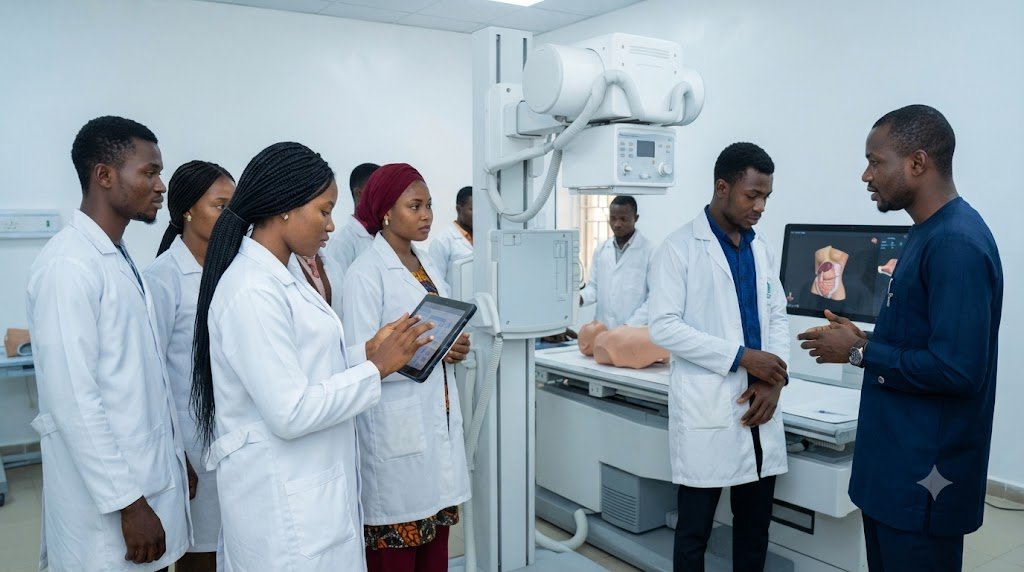



The early indicators are encouraging. Following the Federal Government’s TVET reforms, enrolment for the National Common Entrance Examination into Federal Technical Colleges rose dramatically, from just over 7,500 candidates in 2024 to more than 29,000 in 2025. NABTEB has also recorded increased participation in its National Business Certificate (NBC) and National Technical Certificate (NTC) examinations, suggesting growing public confidence in skills-based education as a viable route to employment, entrepreneurship and self-reliance.
NABTEB’s role, however, extends beyond conducting examinations. The Board is modernising its operations through digital assessment systems, strengthening quality assurance and deepening collaboration with education authorities, industry and development partners. These reforms are intended to ensure that technical qualifications remain credible, relevant and aligned with the competencies required by today’s labour market.
The urgency of these reforms cannot be overstated. Key sectors—including manufacturing, construction, agriculture, automotive services, renewable energy and information technology—continue to face shortages of skilled personnel. Employers routinely report difficulties recruiting qualified welders, electricians, machinists, ICT technicians, plumbers, refrigeration specialists and other middle-level professionals, even as many university graduates struggle to secure employment.
The construction of the Dangote Refinery underscored the scale of the challenge. The project depended heavily on foreign technical expertise in several specialised areas because the domestic supply of skilled personnel was insufficient. Similar capacity gaps remain evident across strategic sectors of the economy, highlighting the need for sustained investment in technical education and workforce development.
Against this backdrop, NABTEB is increasingly serving as more than an examination body. Through competency-based certification, curriculum improvement, support for technical institutions and advocacy for industry-driven training, it is helping to bridge the long-standing disconnect between education and the labour market.
Dr. Aminu has consistently argued that technical education should no longer be viewed as a second-choice option for students who miss university admission. Rather, it should be recognised as a respected pathway to innovation, entrepreneurship, industrial productivity and national competitiveness. That perspective reflects the realities of today’s global economy, where practical skills often translate directly into employment and enterprise.
The experience of countries such as Germany, South Korea, Singapore and China demonstrates the value of sustained investment in technical education. Their industrial success was built not only on strong universities but also on robust systems that produced highly skilled technicians, technologists and vocational professionals. Nigeria’s aspirations for economic diversification and industrial growth will similarly depend on the strength of its skilled workforce.
Achieving that objective requires more than federal policy. State governments must revitalise technical colleges and invest in modern equipment. Industry must expand apprenticeship and workplace training opportunities. Financial institutions should develop products that enable skilled graduates to establish businesses, while employers should place greater value on technical qualifications. Equally important is the need to challenge the long-held perception that vocational education is inferior to university education.
Ultimately, the future of Nigeria’s economy will be determined not by the number of degrees awarded each year but by the quality, relevance and productivity of the nation’s workforce. In that regard, NABTEB occupies a strategic position. Strengthening the institution, sustaining its reforms and expanding access to quality technical and vocational education are investments in Nigeria’s economic future.
The country stands at a defining moment. It can continue producing graduates for jobs that scarcely exist, or it can build a generation of skilled professionals capable of creating enterprises, driving industrialisation and powering economic growth. The latter offers the more sustainable path to national prosperity.





Leave feedback about this