

By Adamu Musa Hassan
Nigeria’s food-security challenge is no longer simply about producing more food. It is also about building the knowledge, technology, skills, finance, infrastructure and markets required to move agricultural production from the farm to a sustainable and profitable value chain.
That is what makes the emerging partnership between the Federal Cooperative College, Oji River (FCCO), Enugu State, and Thailand’s development and academic institutions significant.
What started with discussions over a proposed Thai-Nigeria Sustainable Agricultural Technology Learning Centre has since advanced into a more formal partnership. In August 2026, the Thailand International Cooperation Agency (TICA), Kasetsart University and FCCO signed a Record of Discussions on the proposed centre, while Kasetsart University and FCCO also signed a Memorandum of Understanding. The agreements were witnessed by Thailand’s Deputy Prime Minister and Foreign Minister, Sihasak Phuangketkeow, and Nigeria’s Minister of State for Agriculture and Food Security, Senator Aliyu Sabi Abdullahi.
The development reflects an increasingly important lesson for Nigeria: the country’s agricultural challenges are too complex to be addressed by individual institutions working in isolation.
The proposed centre offers an opportunity to bring together agricultural education, international technical cooperation, research, technology transfer, cooperative development and enterprise creation under one framework.
At the heart of the partnership is the development of practical skills in areas including aquaculture and small-scale agricultural machinery. But its potential reach is considerably wider.
Aquaculture, for instance, is not limited to fish production. A viable fish-production industry requires hatcheries, quality fingerlings, feed production, pond construction, water management, equipment maintenance, transportation, cold storage, processing, packaging and marketing. Each stage creates room for businesses, skilled workers and supporting services.
This is where the employment potential becomes important.
For a country with a large and growing youthful population, agriculture must increasingly be presented as a modern economic sector capable of generating careers and businesses across the value chain, not simply as subsistence farming.
FCCO is well placed to contribute to that transition because of its mandate in cooperative education, training and enterprise development.
The proposed learning centre could provide a practical platform where students, farmers, cooperative societies and young entrepreneurs acquire skills that can be applied directly to production and agribusiness. FCCO management has also indicated that the centre could train at least 100 participants annually and potentially serve trainees from across Nigeria and West Africa.
The real opportunity, however, lies beyond the number trained inside the centre.
A trained aquaculture entrepreneur can employ farm hands, purchase feed, contract transporters, engage processors and sell to retailers. A cooperative equipped with appropriate machinery can provide mechanisation services to hundreds of smallholder farmers. A trained agro-processor can create demand for crops produced by surrounding farmers.
The multiplier effect can therefore be far greater than the institution’s direct enrolment. This is also where the cooperative model becomes relevant.
Nigeria does not need technologies imported wholesale and expected to succeed under completely different conditions. Technologies must be adapted to Nigerian soil, climate, water availability, farm sizes, labour patterns, markets and local production practices.



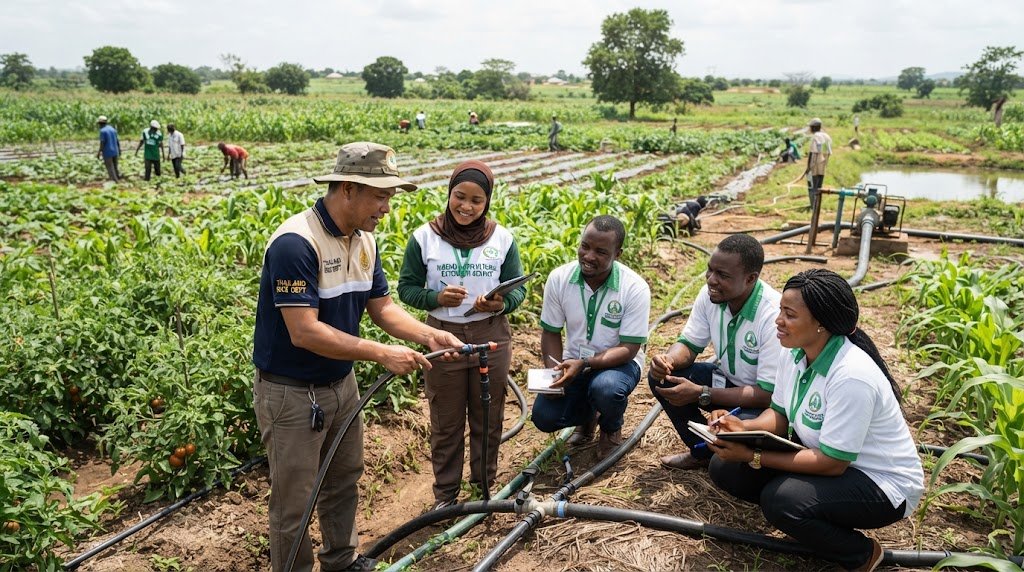

The value of international cooperation is therefore greatest when it builds Nigerian capacity to use, adapt and eventually improve the technology.
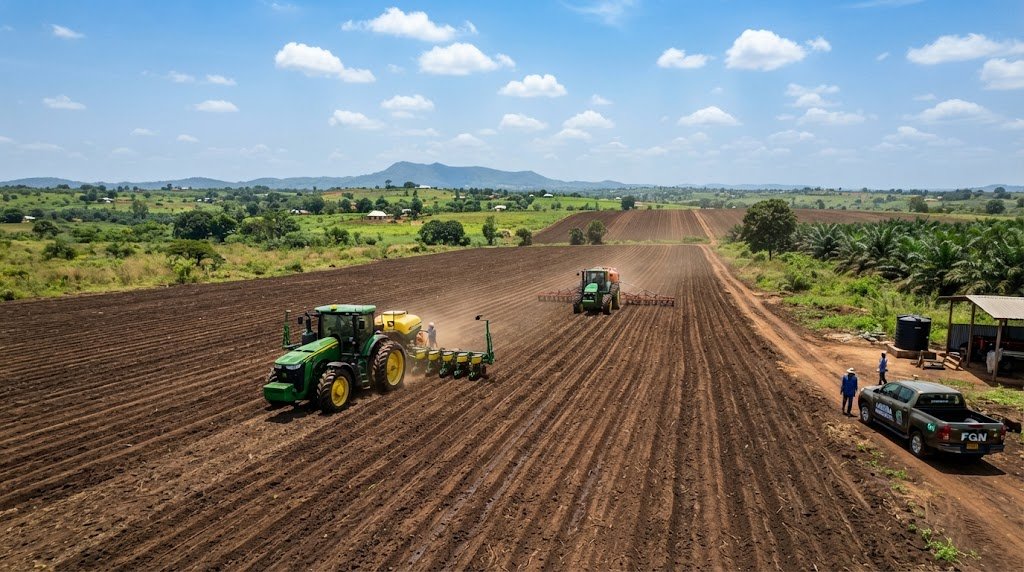
The focus on small-scale mechanisation could be particularly useful. Many Nigerian farmers operate on relatively small holdings and cannot individually afford expensive machinery. Cooperative ownership and shared-equipment models could make appropriate mechanisation more accessible while reducing production costs and labour constraints.
The same approach can be extended to irrigation, processing, storage, renewable energy, feed production and post-harvest management.
Nigeria’s wider agricultural policy direction is already moving towards this integrated approach.
The Federal Government’s National Agricultural Growth Scheme–Agro-Pocket (NAGS-AP) 2.0, approved in 2026, focuses on improving access to agricultural inputs, strengthening value chains, revitalising extension services and promoting digital and climate-smart agriculture.
The National Agricultural Development Fund (NADF) is also supporting agricultural production through financing, input interventions, research, capacity building and other measures aimed at improving productivity and reducing constraints across the agricultural value chain.
These initiatives underline a basic reality: fertiliser, improved seeds and other farm inputs are important, but they cannot by themselves deliver lasting food security.
Farmers also need knowledge, extension services, finance, technology, infrastructure, storage facilities and dependable markets.
That is where institutions such as FCCO can make a difference.
An agricultural institution that combines technical training with cooperative education and enterprise development can help produce a new category of agricultural professionals: farm managers, aquaculture entrepreneurs, agro-processors, equipment operators, cooperative managers, extension service providers, feed producers and other agribusiness specialists.
Such an approach also gives young Nigerians a stronger reason to view agriculture as a business and profession.
The proposed centre’s possible adoption of an integrated farming model further strengthens its potential.
FCCO management has pointed to the Songhai model in Benin Republic, where crop production, livestock, aquaculture, agro-processing, waste recycling and renewable energy are linked within a circular production system.
The underlying principle is simple: waste from one agricultural activity can become an input for another.
Crop residues can support livestock production. Animal waste can contribute to fertiliser or aquaculture systems. Processing waste can be reused, while renewable energy can reduce operating costs.
For Nigerian farmers and processors facing high energy and production costs, such models deserve practical testing.
If adapted successfully to Nigerian conditions, Oji River could become more than a training centre. It could serve as a demonstration site for integrated and circular agriculture, where production, training, research and enterprise development reinforce one another.
The partnership has also attracted wider institutional interest. The August engagement involved CGIAR Nigeria/IITA, alongside TICA, Kasetsart University and FCCO, pointing to the potential for a broader network connecting research, development cooperation, agricultural education and practical production.
That is the kind of institutional linkage Nigeria needs to strengthen.
Government can provide policy and regulatory support. Universities and research institutions can generate knowledge and innovations. Development partners can provide technical cooperation. Colleges such as FCCO can translate knowledge into practical skills. Private companies can develop markets and commercialise technologies, while cooperatives can aggregate producers and connect them to services and buyers.
The critical question is whether these relationships will produce measurable results.
Nigeria has seen numerous agricultural agreements and initiatives over the years. Their ultimate value has always been determined not by the number of ceremonies held or documents signed, but by what reaches the farmer.
For the FCCO–Thailand initiative, implementation should therefore be accompanied by clear and measurable targets: trainees produced, farmers reached, technologies demonstrated, enterprises established, cooperatives supported, jobs created, production increased and innovations commercialised.
There should also be a deliberate strategy for taking successful models beyond Oji River.
An aquaculture technique that works in Enugu should be tested in other parts of Nigeria where conditions permit. Small-scale mechanisation models should be adapted for different agricultural zones. Lessons from the project should be shared with other agricultural colleges, universities, research institutes, cooperative societies and state agricultural authorities.
That is how an institutional partnership becomes a national development asset.
The possibility of wider regional cooperation also adds to the significance of the initiative. Thai officials have indicated that the Oji River project could provide a foundation for broader cooperation, including potential engagement with regional and continental institutions.
Nigeria is well positioned to serve as a hub for agricultural knowledge and enterprise in West Africa, but only if its institutions can convert its huge agricultural market and workforce into productive capacity.
For young Nigerians, that conversion is particularly important.
The recurring call for youths to “go into agriculture” will achieve little if agriculture continues to be associated mainly with subsistence production, inadequate infrastructure and weak market access. Young people need pathways into modern farming, agricultural technology, processing, logistics, finance, research and digital services.
Institutional partnerships can help create those pathways.
They can connect farmers to technology, researchers to producers, cooperatives to markets and young people to practical skills. They can also provide a mechanism for adapting international experience to Nigerian circumstances.
The FCCO–Thailand partnership should therefore be viewed within this broader context.
Its promise is not simply that Nigeria will gain another agricultural training facility. Its greater potential is to demonstrate how an educational institution can become a meeting point for international expertise, research, cooperative development, agricultural production and enterprise creation.
But the distinction between promise and impact will be implementation.
The project will require sustained funding, accountable management, private-sector participation, appropriate technology, strong links with research institutions and a clear mechanism for measuring outcomes. It must also remain focused on the realities of Nigerian farmers and businesses.
Nigeria does not need another agricultural initiative that generates attention at launch and disappears from public view thereafter.
It needs institutions that continue producing skilled people, viable enterprises, useful technologies and measurable economic value long after the signing ceremonies are over.
The Oji River initiative has the opportunity to become one of those institutions.
If FCCO, TICA and Kasetsart University can translate their partnership into functioning facilities, practical training, technology transfer and commercially viable agricultural enterprises—and if Nigerian government agencies, research institutions, investors and cooperatives are deliberately linked to the process—the project could provide a useful model of how international cooperation can strengthen domestic capacity.
For Nigeria, the ultimate test is straightforward: Can the partnership help produce more food, equip more people with useful skills and create more sustainable livelihoods?
If the answer is demonstrated on the ground, Oji River will have achieved something much bigger than the establishment of a learning centre.
It will have shown how institutional linkage can turn agricultural knowledge into production, technology into enterprise, cooperation into jobs and international partnership into tangible food-security gains.




Leave feedback about this