

By Oyeyemi Abolade
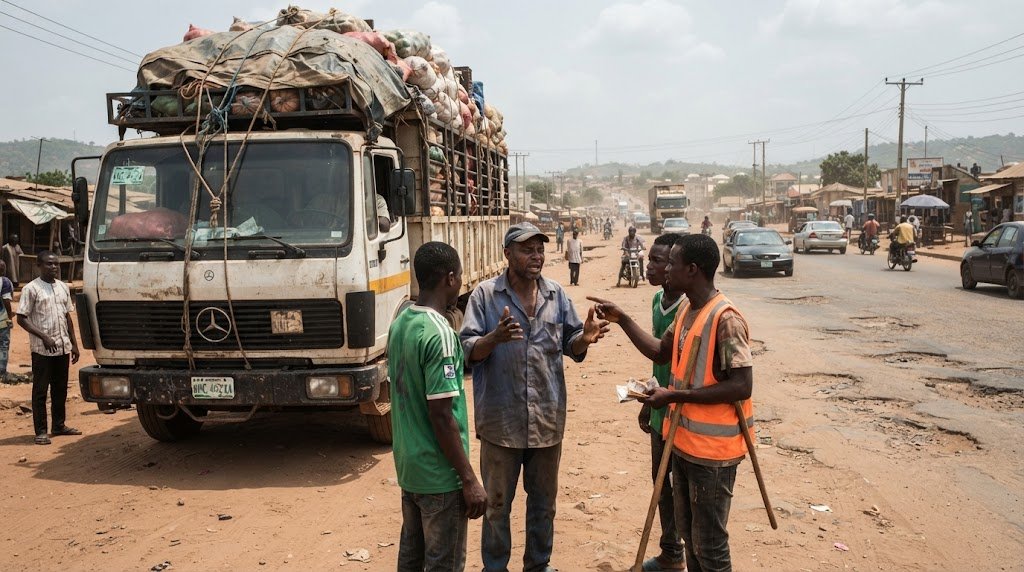
In Nigeria’s bustling informal economy, traders and transport operators routinely make payments whose purpose, legal basis and beneficiaries are often unclear.
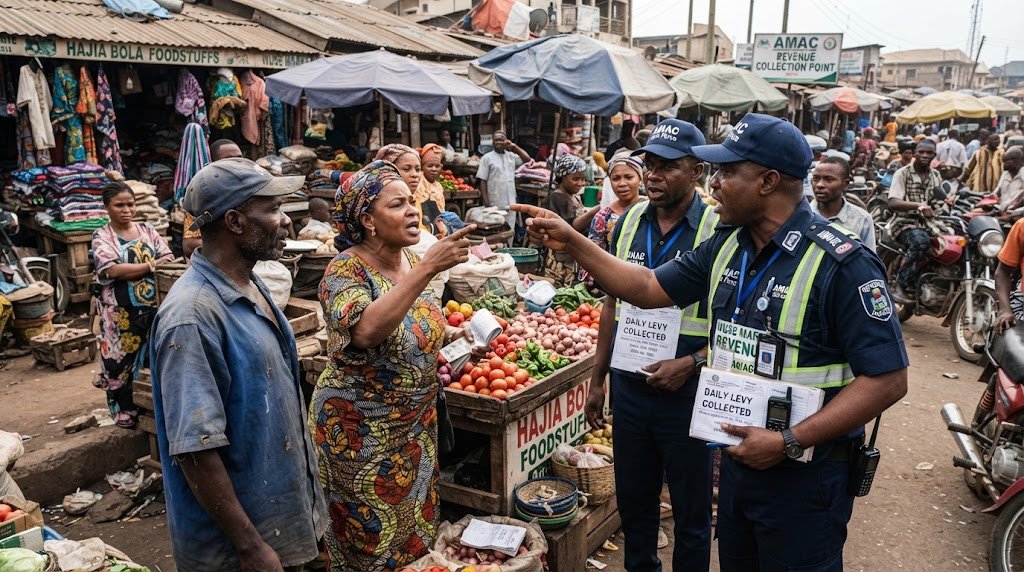
Across markets and transport hubs, these charges are collected daily, weekly, monthly or annually. They may be described as dues, tickets, sanitation fees, security contributions or development levies. In many cases, however, those who pay say they receive little explanation about what the money is for or how it is accounted for.
The result is a parallel system of revenue collection operating alongside formal taxation, often with limited transparency.
From Jabi Market in Abuja to commercial centres in other major cities, traders and transport workers face multiple financial demands that add to the cost of doing business. For many, refusal to pay can result in intimidation, the closure of shops or other forms of pressure.
This investigation examines the collection of such levies in Abuja, how the system operates, what traders and transport operators receive in return, and why concerns about accountability persist.


Multiple Levies, Little Clarity
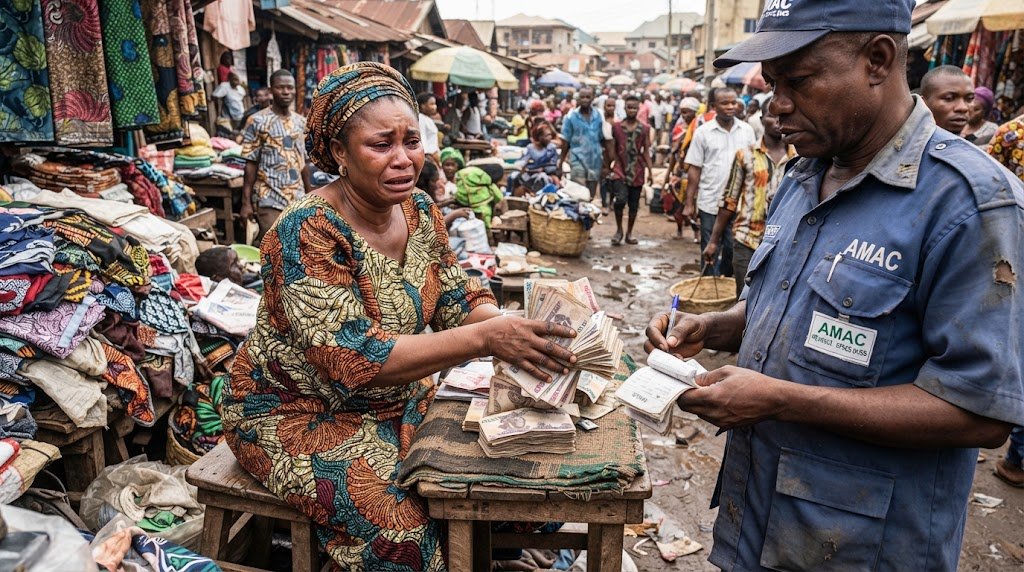
Obi Jonathan, an electronics trader at Jabi Market, said he makes several payments to market authorities, ranging from daily and weekly dues to monthly and annual levies.
“They don’t tell us what the levies are called,” he said.
According to Jonathan, traders pay a daily levy, ₦1,000 every Monday, about ₦5,000 at the end of the month—although the amount varies from shop to shop—and another ₦500 per shop on the last Saturday of each month. An additional levy is imposed at the end of the year.
“We just know it must be paid to the market authorities because that is what we were told,” he said.
For traders, the payments are largely non-negotiable.
“If you don’t pay, they can lock your shop or seize your goods,” Jonathan added.
The central issue, he said, is not necessarily the payment itself but the absence of clear information about its purpose and the benefits attached to it.
“How are we being helped by the money we pay?” he asked.
His experience reflects a wider concern within Nigeria’s informal economy, where numerous payments can exist outside the better-defined structures of statutory taxation.
Paying Without Seeing Enough in Return
The situation is similar at Karimo District Market in Abuja, although the amounts reportedly vary according to the type and scale of business.
“There are differences. Those selling big pay above ₦10,000 sometimes. For me, I pay about ₦400 once a week,” said Nkechi Mberekpe, a trader.
Mberekpe acknowledged that the market authorities provide some services.
“They clean and secure the market for us. That’s the only benefit for now,” she said.
But the basic services provided do not necessarily resolve questions about the volume, frequency and management of the payments.
Across many markets, traders complain about inadequate infrastructure, inconsistent sanitation, poor drainage and security gaps. These deficiencies raise questions about whether the services provided correspond with the cumulative payments collected from businesses.
The problem is compounded where traders are unable to establish the precise authority under which a levy is imposed, the amount that should legally be paid or the agency responsible for collecting it.
A More Structured System in Transport
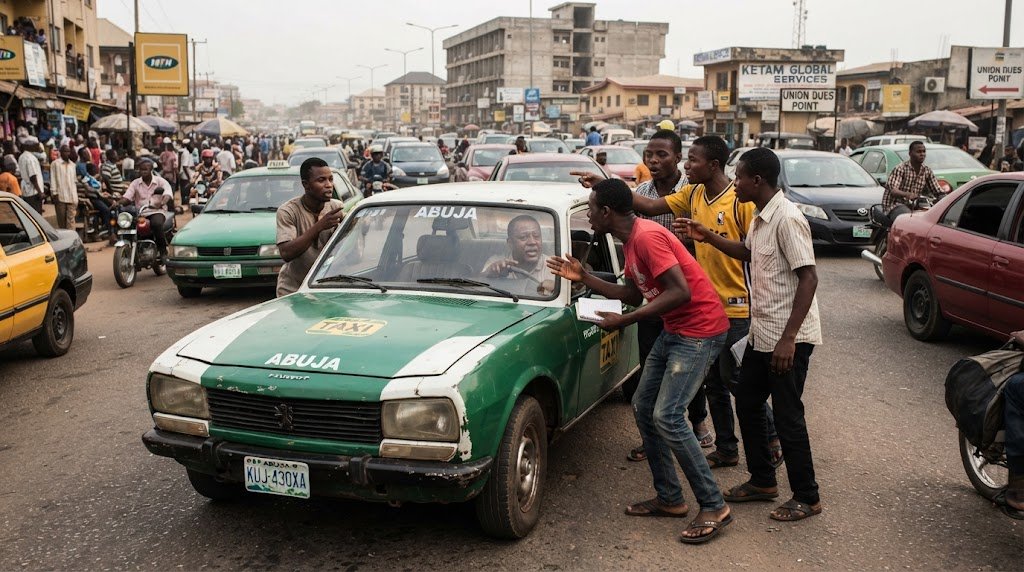
The transport sector presents a somewhat different picture. In Abuja, ticketing and dues associated with transport operations are more organised, with unions playing a prominent role.
Bamiji Ogunyemi, Chairman of the National Union of Road Transport Workers (NURTW) Taxi Cab Branch 4, Jabi, said payments made by drivers are linked to routes and trips.
“Once we carry passengers, we collect money from drivers depending on where they are going. For us in Abuja, it is within the city, and the amount is charged based on the route,” he said.
According to Ogunyemi, part of the revenue supports union administration and member welfare, including assistance to members facing difficulties.
He also said the union operates within a broader regulatory environment involving government authorities, including tax and other compliance obligations.
However, questions about financial transparency remain.
“Since the introduction of CNG, those higher up have not been totally transparent about cash inflow,” Ogunyemi said.
His comment illustrates a wider point: having a formal structure for collecting money does not, by itself, guarantee that members can fully trace how the revenue is generated, distributed or spent.
The Trust Deficit
For Oludamilola Onemano, Senior Programme Officer at BudgIT, the proliferation of compulsory payments risks undermining public confidence in taxation and government revenue systems.
“In Nigeria, beyond statutory taxes like personal income tax and VAT, many people, especially in the informal sector, are required to pay market dues, transport union charges and community levies,” she said.
Although these payments may not always be legally classified as taxes, their compulsory nature gives them a similar effect on those who pay them.
“The increase of these payments creates a fragmented system where citizens face multiple collection points with little transparency,” Onemano said.
The consequence, she explained, is a growing perception that citizens are paying repeatedly without seeing corresponding public benefits.
“When citizens do not see a clear link between what they pay and what they receive, trust in government declines and compliance drops.”
Another concern is the use of intermediaries to collect revenue.
“Many of these payments are handled by intermediaries rather than directly by the state, which makes accountability difficult,” she said.
Where multiple agencies, unions, associations and market authorities collect different charges from the same business or operator, determining the total financial burden and tracing the destination of the funds can become difficult.
Where the Law Falls Short
Nigeria’s recent tax reforms, including the Nigeria Tax Act 2025, are designed to improve tax administration and broaden compliance. But the informal levy system remains a more complicated area involving government agencies, local authorities, unions, associations and market management structures.
Taxation researcher Timothy Onechojon Usman argues that the challenge is not simply the absence of laws but the weakness of enforcement and coordination.
“Nothing significant has changed in the tax laws about informal tax collection,” he said.
According to Usman, the persistence of informal levies is closely linked to the capacity of institutions to regulate and monitor the activities of informal-sector organisations.
“Their prevalence is tied to how much our institutions can curb excesses by informal sector participants,” he explained.
He also questioned the level of coordination among relevant authorities.
“In my opinion, no defined coordination exists, except in some sparse dimensions across some states and local governments.”
Where government systems operate alongside unions, associations and other intermediaries, the boundaries of responsibility can become blurred. This creates a hybrid revenue system that is neither entirely formal nor entirely informal.
A System in Need of Accountability
The evidence from Abuja points to a recurring pattern: traders and transport operators are willing to contribute towards the maintenance and regulation of the spaces in which they work, but they want clarity about what they are paying, who is authorised to collect it and what they receive in return.
The issue is therefore bigger than the amount demanded from individual traders or drivers. It concerns the cumulative burden of multiple charges and the absence of a transparent system for tracking them.
A more credible framework would require clear identification of authorised levies, standardised rates, official receipts, transparent collection channels and accessible mechanisms for resolving disputes. It would also require closer coordination between government agencies, market authorities, unions and associations.
For the informal sector, where margins are often already narrow, unnecessary or duplicated charges can increase operating costs and discourage compliance with legitimate taxation.
Until stronger oversight and clearer accountability are established, traders and transport operators will continue to make payments whose purpose and destination are not always clear.
The questions remain straightforward but fundamental: Who is authorised to collect? What exactly are citizens paying for? How much is collected? And who ultimately accounts for the money?
Those questions deserve clear answers—not only for the sake of traders and drivers, but for the credibility of Nigeria’s broader revenue and governance system.




Leave feedback about this