
The Rivers State political crisis has refused to abate, defying elite interventions, presidential caution and repeated appeals for restraint. What began as a disagreement between a political godfather and his successor has since snowballed into a multilayered struggle involving the presidency, the ruling APC, a polarised House of Assembly and a deeply divided political class.
At stake is not just the future of Governor Siminalayi Fubara or the relevance of Nyesom Wike, but the stability of one of Nigeria’s most strategic states. President Bola Ahmed Tinubu has intervened in the Rivers crisis more than three times, underscoring the gravity of the situ-ation.
From brokering agreements in Abuja to approving extraordinary measures aimed at restoring calm, the President has consistently sought to prevent Rivers from sliding into a full-blown con-stitutional breakdown. Yet, each intervention appears to have merely postponed, rather than resolved, the conflict.
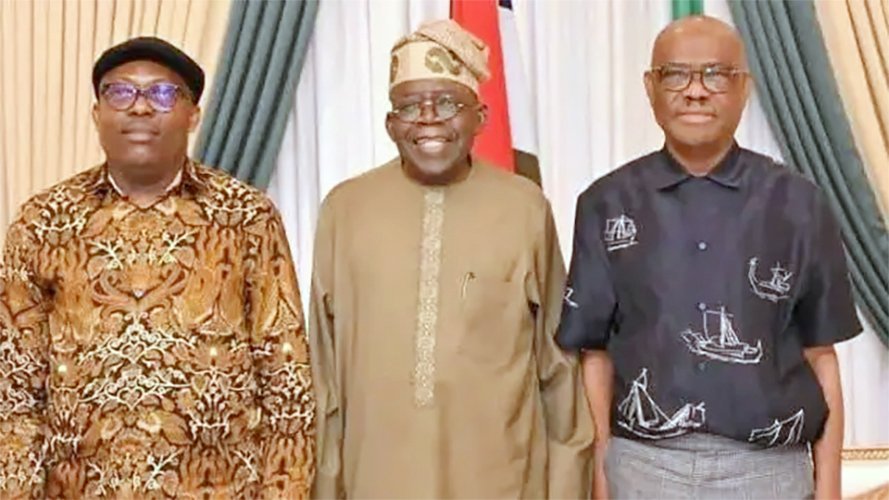
At the centre of the dispute is an agreement reportedly reached and signed by both Wike and Fubara in the presence of President Tinubu. While the full details remain shrouded in secrecy, Wike has repeatedly accused Fubara of reneging on the pact. Political insiders suggest the understanding went beyond administrative cooperation and may have included a commitment by Fubara to limit himself to one term in office.
Whether such an agreement was explicit or implied, its collapse triggered mutual suspicion. Matters worsened when Tinubu suspended Fubara for six months – a move many interpreted as a calculated attempt to save the governor from an imminent impeachment by the Martin Amaewhule-led Rivers State House of Assembly. That suspension, though controversial, effec-tively froze the conflict and reset the chessboard.
APC Defection And A Shift In Power Calculation
The political equation changed dramatically the moment Fubara joined the ruling APC. Over-night, the embattled governor found himself shielded by the party at the centre, with several APC governors quietly rallying behind him. This development unsettled Wike, who had long dominated Rivers’ political structure and delivered massive votes for President Tinubu in the 2023 elections.
What followed was a fierce counter-offensive. Wike toured 22 of the 23 local government areas in Rivers State, openly campaigning against Fubara’s re-election. The only local government he avoided was that of the governor — a silence louder than words. In the process, Wike declared that Rivers no longer recognises party boundaries, insisting that what exists is the “Renewed Hope family”, with himself as its leader.
The Rivers State House of Assembly soon re-awakened impeachment proceedings against Fubara, citing allegations of financial misappropriation, constitutional breaches and executive overreach. Under Nigeria’s constitution, a governor can be impeached if two-thirds of lawmakers endorse a notice of allegations, followed by an investigative panel and final legislative approval.
On paper, the Amaewhule-led Assembly appears numerically strong. However, legality is not determined by numbers alone. The deep division within the House, lingering questions about legitimacy following prolonged political disruptions, and the unmistakable shadow of federal interest all complicate the path to impeachment. Without tacit presidential consent, any impeachment effort in Rivers risks collapsing under political and legal scrutiny.
Amid escalating tensions, a state level reconciliation committee was constituted, comprising respected traditional rulers, elder statesmen and key political stakeholders. The committee was tasked with de-escalating hostilities and finding a political solution acceptable to all sides. Its involvement initially yielded cautious optimism, particularly when four lawmakers — Hon. Sylvanus Nwankwo, Hon. Peter Abbey, Hon. Barile Nwakoh and Hon. Emilia Amadi — publicly withdrew from the impeachment push.
At the time, they cited appeals from elders, security concerns and President Tinubu’s caution against plunging the state into chaos. However, that optimism proved short-lived. On Friday, the same lawmakers reversed their stance, rejoining their colleagues and accusing the governor of failing to genuinely engage in reconciliation. Their return to the impeachment camp signalled the renewal of the godfather protégé war.
The Rivers crisis has also exposed fault lines within the APC. While National Secretary Ajibola Basiru is perceived to be sympathetic to Fubara, the party’s South-South leadership – Victor Giadom – has openly aligned with Wike. APC Governors’ Forum Chairman, Hope Uzodinma, has not been spared, as the disagreement threatens party cohesion ahead of 2027.
Compounding matters are Wike’s controversial remarks suggesting he fears no one and that the President could remove him as FCT Minister if he so desires. Though his camp insists these comments were misconstrued, opposition figures have seized upon them to suggest a brewing rift between Wike and Tinubu.
What Chance Does Impeachment Truly Have?
Realistically, the Amaewhule-led Assembly faces an uphill battle. An impeachment carried out against a sitting governor who belongs to the ruling party, enjoys the backing of APC governors and remains under the watchful eye of the President would be politically explosive. Tinubu, ever the strategist, is unlikely to endorse a process that could destabilise Rivers and weaken APC’s national outlook.
The most realistic resolution lies not in impeachment, but in political accommodation. Fubara should be allowed to finish his tenure in peace, focusing on governance rather than survival. Wike, as a key stakeholder and federal minister, retains enormous influence and can deploy it to stabilise rather than inflame the state.
Both camps must recognise a shared political interest: delivering Rivers State for President Tinubu in 2027. If, as Wike asserts, Rivers belongs to the Renewed Hope family, then internal warfare only undermines that family’s strength.
Equally critical is the need for both sides to tone down inflammatory rhetoric and chants of war. Political disagreements need not translate into existential battles. The reconciliation com-mittee should be strengthened, dialogue sustained, and all actors reminded that Rivers’ peace is bigger than individual ambition.
Tinubu’s Final Call
Ultimately, the crisis will return to President Tinubu’s table. His challenge is delicate: balancing loyalty, reward, discipline and national stability. Whether through renewed mediation, firm political directives or strategic compromise, Tinubu’s decision will define not just the fate of Wike and Fubara, but the political direction of Rivers State.
Until then, Rivers remains caught between power and peace, waiting to see whether reason will prevail over rivalry.