

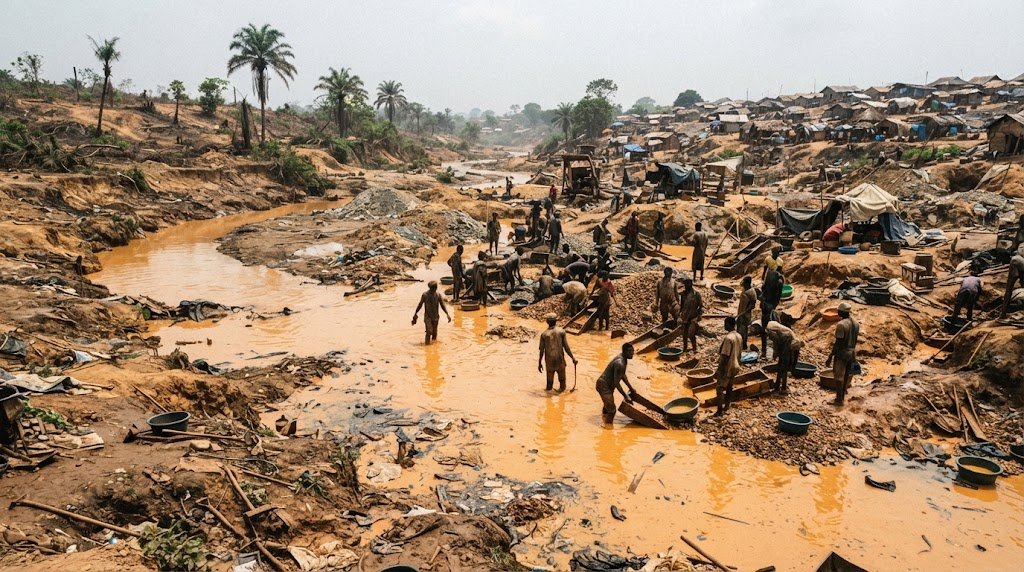
Nigeria’s mineral wealth should be a foundation for economic diversification, industrial development and shared prosperity. Instead, the persistence of illegal mining continues to expose the country to revenue losses, environmental degradation, insecurity and avoidable human tragedies.
The reported death of 37 artisanal miners in the custody of the Nigeria Security and Civil Defence Corps (NSCDC) in Niger State on Thursday, September 17, 2026, has brought these concerns into sharp public focus.
The victims were among suspected illegal miners arrested around the M.I. Wushishi–Lukoto axis, west of Minna, during enforcement operations on September 15 and 16. Reports initially put the death toll at 33 before subsequent official reporting referred to 37 deaths.
However, the circumstances surrounding the deaths have generated serious public concern. The NSCDC initially referred to a suspected disease outbreak, while other accounts raised questions about detention conditions, including alleged overcrowding and poor ventilation. These remain competing accounts pending the outcome of the investigation and should not be treated as established facts.
However, the Federal Government has since taken steps towards establishing what happened, including the constitution of a 10-member independent committee by the Minister of Interior following President Bola Tinubu’s directive for a comprehensive investigation. Officers reportedly connected with the incident have also been suspended and detained pending the outcome of the probe.
Reacting to the incident, the Centre for Peace Transparency and Accountability (CPTA) has welcomed these measures while calling for a thorough, independent, transparent and unhindered investigation. The Centre, in a statement signed by its Executive Director, Comrade Patrick Onomuodeke, said the circumstances and causes of the deaths must be fully established and warned against allowing the matter to disappear from public attention.
The Centre has urged investigators to establish the identities and exact number of those who died, their condition when arrested, the number of detainees held, the conditions in which they were kept, the adequacy of ventilation, sanitation, food, water and medical attention, the timeline of events and whether emergency assistance was promptly provided.
It also called for investigation into possible failures of command, supervision, communication and emergency response, as well as whether negligence, misconduct, abuse or other unlawful conduct contributed to the deaths.
Those questions are legitimate. A person arrested on suspicion of illegal mining does not lose his fundamental rights. Enforcement of mining laws and protection of human dignity are not mutually exclusive obligations.
A Crisis Beyond the Mining Pits
Illegal mining is no longer simply a violation of mining regulations. It has become a multidimensional economic, environmental and security challenge.
The Nigeria Extractive Industries Transparency Initiative (NEITI), in its 2023 Solid Minerals Industry Audit Report, noted that the solid minerals sector contributed less than one per cent to Nigeria’s GDP and accounted for only 0.31 per cent of total exports. The report identified illegal mining and the underutilisation of Nigeria’s mineral resources among challenges limiting the sector’s development.
This is a troubling contradiction for a country endowed with commercially valuable deposits of gold, tin, columbite, lithium, tantalite, iron ore and other minerals.
The problem is therefore not the absence of resources. It is the failure to consistently convert those resources into lawful economic activity, public revenue, industrial production and sustainable livelihoods.
The Human Cost of Unsafe Mining
The human cost of unsafe and unregulated mining is repeatedly demonstrated across the country.
In September 2025, a mining pit collapsed at Kadauri in Maru Local Government Area of Zamfara State. The Federal Ministry of Information reported that 15 itinerant mine workers were trapped, with 13 bodies recovered at the time of its update. The ministry linked the collapse to heavy rainfall compounded by unlawful mining activities.
Similarly in Plateau State, four miners died in September 2025 after a mining site collapsed in Dura community, Jos South Local Government Area. Another tragedy occurred in Kano State in July 2026, when three artisanal miners reportedly died in Riruwai, Doguwa Local Government Area, after inhaling toxic fumes inside a mining pit.
In August 2026, seven miners were also reported dead following the collapse of a mining pit in Kassa community, Barkin Ladi Local Government Area of Plateau State, according to Premium Times.
These incidents, occurring in different states and under different circumstances, reveal a persistent safety challenge. Workers continue to enter hazardous mining environments without adequate geological assessment, ventilation, protective equipment, emergency systems or effective regulatory supervision.
For many artisanal miners, however, mining is also a livelihood. That reality makes the challenge more complex. Enforcement must address criminal syndicates and unlawful operators while creating viable pathways for legitimate artisanal miners to enter the formal economy.
The Mining Marshals Intervention
It is against this backdrop that the NSCDC Mining Marshals initiative assumes considerable importance.
Under Commandant General Abubakar Audi Ahmed, the Corps has expanded its role in protecting critical national assets and infrastructure to include a specialised response to illegal mining.
In March 2024, the Federal Government inaugurated more than 2,000 Mining Marshals under the NSCDC to combat illegal mining and apprehend violators of mining laws. The initiative was designed to provide a dedicated security component for protecting mining sites and supporting enforcement of the country’s mining regulations.
The importance of the Mining Marshals lies in specialisation. Illegal mining requires more than periodic raids. It requires personnel who understand the mining environment, identify unlawful extraction sites, secure mineral-bearing areas, support investigations and work closely with mining regulators and other security agencies.
There have been indications of progress. Reporting on the initiative in 2025, The Guardian noted that the Mining Marshals had contributed to a reduction in some illegal mining activities and the looting of mineral resources, although challenges involving logistics, inter-agency coordination and community cooperation remained.
These results provide a basis for strengthening, rather than abandoning, the initiative.
The Revenue Nigeria Is Losing
Illegal mining is also an economic leakage problem.
When minerals are extracted without valid licences, accurately recorded production volumes or payment of applicable royalties and fees, government loses revenue at several points in the value chain.
NEITI’s 2023 audit recorded solid mineral production of approximately 95.07 million tonnes, royalties of about ₦9.01 billion and exports valued at approximately ₦117.29 billion. These figures should not be interpreted as the precise amount lost exclusively to illegal mining, but they underline the importance of effective production monitoring, revenue reconciliation and regulatory enforcement.
The economic damage goes beyond unpaid royalties.
Illegal operators compete unfairly with licensed companies that invest in equipment, worker safety, environmental compliance and regulatory fees. Unregulated extraction also discourages responsible investment, deprives communities of lawful economic opportunities and reduces the possibility of developing domestic mineral-processing industries.
Nigeria therefore loses twice: first through immediate revenue leakage and again through the missed opportunity to build industries and jobs around its mineral resources.
From Raids to Sustainable Governance
A durable response requires a combination of enforcement, formalisation and accountability.
First, illegal mining syndicates and financiers must be investigated and prosecuted where evidence supports criminal liability.
Second, artisanal miners willing to operate lawfully should have accessible routes into cooperatives, licensing arrangements, technical training and safer mining practices.
Third, environmental restoration must form part of mining governance. Abandoned pits, polluted water sources and degraded agricultural land impose long-term costs on communities and governments.
Fourth, intelligence sharing among the NSCDC, Ministry of Solid Minerals Development, Mining Cadastre Office, police, customs authorities, financial intelligence institutions and state governments must be strengthened.
Most importantly, every enforcement operation must respect due process and human dignity.
The Niger State deaths make this imperative particularly clear. The independent investigation must establish the facts, determine responsibility where wrongdoing is established and ensure that lessons are translated into institutional reforms.
Protecting a National Asset
Nigeria cannot afford to allow its mineral wealth to become a source of insecurity, environmental destruction, revenue leakage and preventable deaths.
The NSCDC Mining Marshals represent an important institutional response to a problem that has persisted for too long. Their effectiveness, however, will depend on adequate resources, professional training, inter-agency cooperation, intelligence-led operations, measurable results and strict adherence to the law.
The country needs an enforcement architecture that is firm against criminal exploitation, fair to vulnerable workers and transparent before the public.
Nigeria’s mineral resources belong to the Nigerian people. Their exploitation should finance development, create jobs and strengthen the economy—not deepen insecurity or human suffering.
The objective must therefore be clear: protect the nation’s mineral wealth, protect the people who depend on it for their livelihoods, and ensure that the wealth beneath Nigeria’s soil translates into legitimate prosperity above it.