

By Clement Asokwu
In agricultural communities, access to productive assets can be as important as access to land, inputs and markets. A farmer may harvest quality produce, but without reliable transportation, getting that produce from the farm to the market can become an expensive and difficult undertaking.
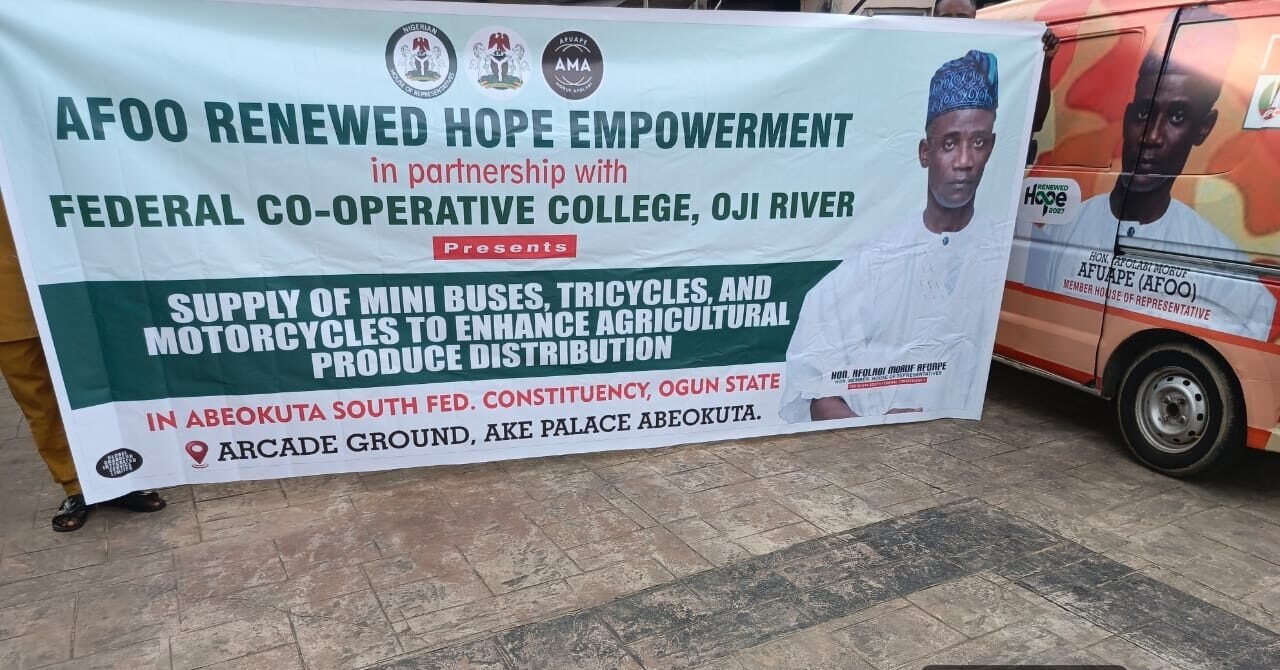
It is against this backdrop that the distribution of 52 transport assets comprising 15 minibuses, 15 tricycles and 22 motorcycles in Abeokuta South Federal Constituency, Ogun State project assumes particular significance.
The intervention, sponsored by Hon. Afolabi Moruf Afuape, Member representing Abeokuta South Federal Constituency, and executed through the Federal Cooperative College, Oji River, is designed around a straightforward economic proposition: improve the means available to beneficiaries to move agricultural produce while providing productive assets that can support livelihoods.
The scale of the intervention is perhaps best appreciated not simply by counting the vehicles, but by considering what reliable mobility means within an agricultural value chain.
From farms and production centres to collection points, markets and other distribution locations, transportation remains a critical link. Where that link is weak, delays, additional costs and post-harvest losses can affect producers and traders. Where it is strengthened, opportunities emerge for faster movement of goods and more efficient participation in local commerce.
Beyond the stated objective, the project has also gone through a field monitoring and inspection process.
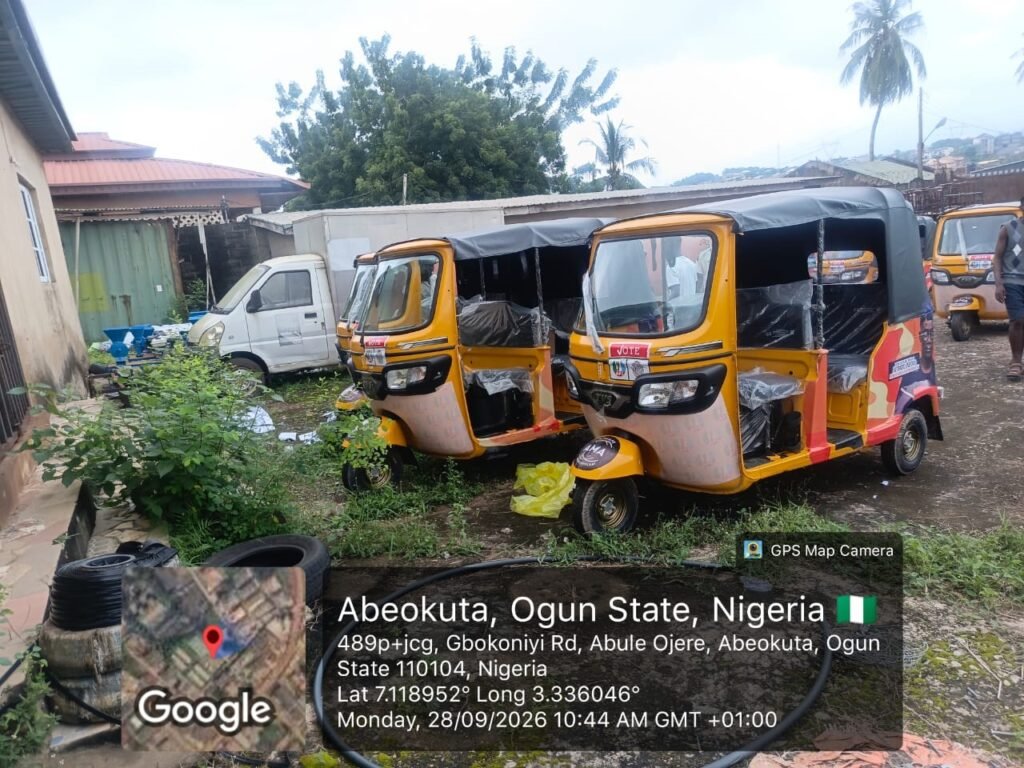
According to the Field Monitoring and Inspection Report dated September 28, 2026, the monitoring team physically inspected the assets at the warehouse before distribution. The inspection further reported that the entire fleet was in good condition at the time of verification.
For a project of this nature, such field-level verification is significant because it provides a physical basis for documenting the transition from procurement to actual distribution.













Transport As An Empowerment Tool
The distinguishing feature of the intervention is its emphasis on productive transportation rather than transportation merely as a convenience.
The minibuses, tricycles and motorcycles can serve different mobility requirements within the constituency. While the minibuses provide higher-capacity movement, the tricycles and motorcycles offer greater flexibility for accessing locations where larger vehicles may face limitations.
Together, the assets create a diversified transportation pool capable of supporting different stages of agricultural distribution.
For beneficiaries, the significance extends beyond ownership of a vehicle. Properly deployed and maintained, productive assets can become instruments for income generation, enterprise development and participation in the agricultural value chain.
The monitoring report accordingly describes the initiative as having a positive empowerment dimension, particularly because beneficiaries are being provided with assets intended to support economic activities.
Its longer-term value, however, will ultimately depend on how effectively the beneficiaries deploy the assets, maintain them and integrate them into sustainable economic activities.
Another notable feature of the distribution exercise was the involvement of community stakeholders.
Traditional rulers, farmers’ cooperative representatives and members of the community were present during the distribution. Their participation provided community-level visibility to the exercise and offered an additional layer of public confirmation of the presentation of the assets to beneficiaries.
This kind of stakeholder participation is particularly relevant to constituency-level interventions, where the effectiveness of a project is closely connected to how well beneficiaries and community institutions understand and utilise the intervention.
The project also formed part of a broader empowerment ceremony during which other items, including sewing machines and grinding machines, were distributed. The monitoring report makes clear, however, that those additional items were outside the specific scope of the transport-assets assignment.
Beyond The Distribution Ceremony
The real measure of an empowerment intervention is what happens after the ceremony.
For the Abeokuta South transport project, the immediate milestone is clear: the specified assets were physically verified and subsequently distributed. The next phase is utilisation.
If effectively deployed, the 52 vehicles have the potential to strengthen agricultural produce distribution, facilitate movement between production areas and markets, and provide beneficiaries with productive economic assets.
That potential makes post-distribution monitoring important. Regular assessment of utilisation, maintenance, beneficiary experience and economic outcomes would provide useful evidence of the project’s longer-term impact.
A Practical Approach To Constituency Empowerment
The Abeokuta South project illustrates a practical dimension of constituency empowerment: putting productive assets directly into the hands of beneficiaries whose economic activities depend on mobility.
Its focus on agricultural produce distribution is particularly relevant in an economy where the journey from production to market can determine how much value producers ultimately retain.
The 52 transport assets therefore represent more than a collection of vehicles. They constitute a mobility intervention within the agricultural value chain—one that seeks to address transportation constraints while creating opportunities for beneficiaries to engage more effectively in economic activity.
As the minibuses, tricycles and motorcycles move beyond the distribution ground and into communities, farms, markets and commercial routes, their enduring significance will be measured by the economic activity they help facilitate.
That is where the real story of empowerment begins: not merely with the handing over of an asset, but with what beneficiaries are able to build from it.





Leave feedback about this