

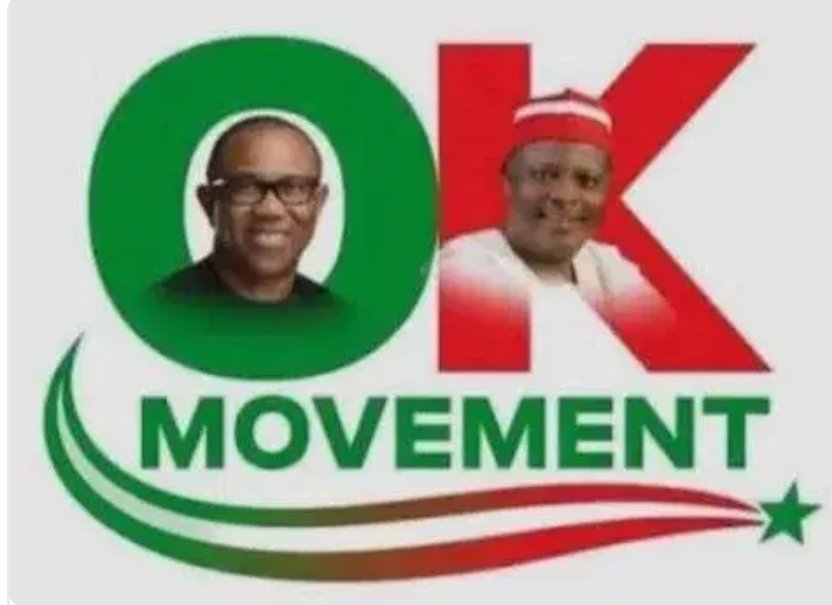
2027: OK Movement Rejects NDC Merger, Vows to Retain Structures
The Obi-Kwankwaso Movement, popularly known as the OK Movement, has rejected any attempt by the Nigeria Democratic Congress to absorb or take control of its organisational structures ahead of the 2027 general elections.
The movement’s Director-General, John Ughulu, said on Wednesday that the organisation would retain its national, state, local government and ward structures, despite its political alignment with the NDC and support for the party’s presidential ticket of Peter Obi and Rabiu Kwankwaso.
Ughulu was reacting to comments by the NDC National Leader, Senator Seriake Dickson, who said political support groups should complement political parties rather than compete with them or establish parallel structures.
Dickson made the remarks on Tuesday while receiving former Secretary to the Government of the Federation, Babachir Lawal, into the NDC in Abuja.
He was speaking against the backdrop of the disagreement between the party and the OK Movement over a 59-member Presidential Campaign Council unveiled by the movement on September 17 to mobilise support for Obi and Kwankwaso.
The NDC subsequently dissociated itself from the council, with its National Chairman, Senator Moses Cleopas, stating that the structure was neither authorised nor constituted by the party. The party maintained that no individual, candidate or support group could establish a campaign structure in its name without approval from the National Working Committee.
Dickson described the establishment of the campaign council by the OK Movement as “nonsensical” and “unheard of”, arguing that support groups should concentrate on grassroots mobilisation and promoting the party and its candidates.
However, Ughulu said the OK Movement should not be treated as an ordinary support group operating as an appendage of the NDC.
“For the avoidance of doubt, the OK Movement is not a support group created as an appendage of any political party or another movement. It is independently organised, managed and structured through its own established movement mechanisms,” he said.
Ughulu maintained that the movement comprised members and supporters drawn from different political parties who shared common political interests around Obi and Kwankwaso.
He consequently rejected Dickson’s description of the movement’s campaign council as nonsensical, arguing that the group was exercising its organisational independence.
“The OK Movement comprises individuals and members from different political parties who share a common commitment to the ideals, values and political aspirations represented by the presidential candidate, Peter Obi, and his running mate, Senator Rabiu Kwankwaso,” he said.
The OK Movement DG said the organisation would continue to mobilise support for the NDC candidates while retaining control of its internal administration and structures.
“The OK Movement remains an independent organisation. Its existence and internal administration are not subject to the internal management of the NDC.
“The OK Movement will not be collapsed, merged or subsumed into the NDC or any other organisation. Cooperation and political alignment do not extinguish the independent identity of the movement,” he said.
Ughulu also said the movement would not surrender its grassroots structures to any political party or external organisation.
“Our organisational structure remains the property and responsibility of the OK Movement. We will not surrender our established national, state, local government and ward structures to any political party or external support group for management,” he added.
He further argued that the movement had the right to establish its own campaign and mobilisation structures in support of the NDC presidential ticket, saying the group was not aware of any provision of the party’s constitution expressly prohibiting such an arrangement.
Ughulu, however, said the movement did not seek to challenge the authority of the NDC over its internal affairs.
“The OK Movement does not claim supremacy over the NDC Party, nor does it seek to usurp the constitutional powers of the party.
“We respect the NDC and recognise the constitutional authority of the party over its own internal affairs. Equally, the NDC and every other organisation must recognise the independent identity, structure and legitimate interests of the OK Movement,” he said.
He warned that the movement would resist any attempt to take over or dissolve its structures.
“We will resist, through lawful and democratic means, any attempt by any individual or group to disenfranchise members of the movement, appropriate its structures, or unilaterally redefine its identity.
“Therefore, no individual can simply declare that structure dissolved, transferred or absorbed without the authority of the Movement’s legitimate organs. We will not be intimidated, surrender our identity or abandon the structures we have built,” he said.
The latest disagreement is the continuation of tensions between the NDC and the OK Movement following the party’s rejection of the 59-member campaign council.
The council, announced by Ughulu, included zonal and state coordinators as well as directorates for mobilisation, strategy, security, legal affairs and other areas.
The OK Movement had also previously affirmed its independence from any merger or absorption into another political organisation, while retaining Ughulu as its Director-General.
The dispute therefore centres on the extent to which an independent political support movement backing a party’s candidates can maintain its own organisational structures while operating in support of the party’s electoral campaign.



Leave feedback about this