

By Umar Farouk Bala
When the apartheid regime finally buckled under the collective weight of African solidarity in 1994, Nelson Mandela did not forget who had carried the heaviest load.
On his visit to Nigeria — the country that had poured an estimated $60 billion into the liberation struggle — Mandela stood before a crowd and affirmed what all of Africa already knew: Nigeria had made the highest donation to South Africa’s freedom.
Winnie Mandela, who accompanied him to the podium, was even more direct. “We owe much of our freedom to Nigeria,” she told the crowd. “I want to take this opportunity to say thank you, Nigeria.”
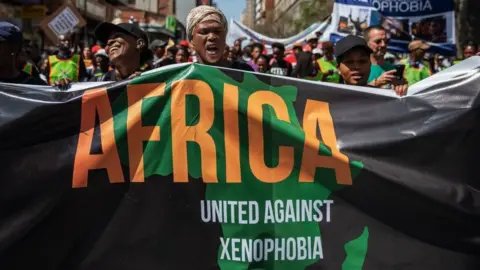
Thirty-two years on, the children and grandchildren of those who sacrificed are being burnt alive in the streets of Johannesburg and Pretoria — by the very people their parents helped to set free.
This is not hyperbole. It is a documented, recurring, and increasingly deadly pattern. In late April 2026, a fresh wave of xenophobic violence swept through South Africa’s major cities.
According to the Nigerian Consulate in Johannesburg, at least two Nigerians have been killed as a consequence of the xenophobic tensions and attacks. Their names are Amaramiro Emmanuel and Ekpeyong Andrew.
These acts of collective savagery are not new, the years 2015 and 2019 saw extensive waves of attacks that destroyed billions of naira worth of Nigerian-owned property and businesses. Now, in 2026, a new surge has triggered the most serious diplomatic rupture between the two countries in years.
By early JUNE 2026, Nigeria’s Minister of Foreign Affairs, Bianca Odumegwu-Ojukwu, announced that at least 130 Nigerians had formally registered for voluntary repatriation flights. She stressed that the safety of Nigerians abroad remained the government’s top priority and that “Nigerian lives and businesses in SA must not continue to be put at risk.”
The Betrayal of Black Racial Solidarity
To understand why this violence cuts so deep for Nigerians — and indeed for all of West Africa — one must return to history.
Nigeria’s role in the anti-apartheid struggle was not peripheral. It was foundational, costly, and sustained over more than three decades.
Nigeria’s formal commitment to South Africa’s liberation began almost immediately after independence. On 4 April 1961, Prime Minister Sir Abubakar Tafawa Balewa sent a formal message of solidarity to the ANC, marking one of the earliest official endorsements of the liberation struggle by any African government. Nigeria also used its position within the Commonwealth to push for South Africa’s diplomatic isolation.
From the early 1960s, Nigeria began providing direct financial assistance to both the ANC and the Pan Africanist Congress. By 1970, this support had developed into a structured annual subvention of approximately $5 million, sustained over several years, making Nigeria one of the most significant financial contributors to the liberation movement on the African continent.
Nigeria also imposed a long-standing oil embargo on apartheid South Africa, a policy estimated to have cost the country approximately $41 billion in lost revenue — a remarkable act of economic self-denial at a time when Nigeria was navigating its own post-civil war recovery. The embargo reflected a deliberate prioritisation of political principle over economic gain.
Through the Southern African Relief Fund, contributions were mobilised from across Nigerian society — from students, traders, and civil servants. By mid-1977, the fund had raised $10.5 million within six months.
The federal government under General Olusegun Obasanjo contributed $3.7 million, alongside his personal donation. This system of popular contributions became associated with what was called the “Mandela Tax,” reflecting wide public participation in the anti-apartheid effort.
Nigeria boycotted the 1976 Olympics and the 1979 Commonwealth Games at great national cost. It declined to sell oil to the apartheid regime. It provided thousands of South African youths with scholarships to study in Nigerian universities, nursing schools, polytechnics, and colleges of education.
At some point, Nigeria was home to South African freedom fighters, including Thabo Mbeki’s father, Govan Mbeki, as well as other ANC leaders who were hosted on asylum. Thabo Mbeki himself lived in Nigeria from 1976 to 1979.
Nigeria played a leading diplomatic role at the United Nations, chairing the UN Special Committee Against Apartheid for approximately 30 years — the longest tenure of any country in that position.
Ghana’s contribution was equally significant. Under President Kwame Nkrumah — whose Pan-Africanist ideology treated the liberation of all African peoples as a continental imperative — Accra became a strategic base for exiled political activists and liberation organisations.
Ghana provided political sanctuary, travel documentation to activists whose passports had been revoked by Pretoria, and educational opportunities at Ghanaian universities for South African exiles. Nelson Mandela and other ANC figures visited Ghana during this period to receive support that helped sustain organisational activities in exile.
Together, the contributions of Ghana and Nigeria represented one of the most significant expressions of Pan-African solidarity in modern history. And when it was all over, when Mandela walked free and South Africa held its first democratic elections in April 1994, South African companies flooded Nigeria, were given billions of dollars worth of contracts, and came to dominate the country’s banking, retail, and telecommunications sectors. The relationship, in the post-apartheid era, was built substantially on Nigerian goodwill and Nigerian capital.
There is a painful arithmetic at the heart of this crisis. From 1960, when Prime Minister Tafawa Balewa made Africa the centrepiece of Nigeria’s foreign policy, to 1994 during the Abacha administration, Nigeria is estimated to have spent approximately $60 billion on funding the anti-apartheid struggle.
That money could have built schools, hospitals, roads, and industries for Nigerians. It was spent instead in solidarity with a people who were suffering. The children of those who made that choice are now being hunted in the streets of the nation their parents helped to liberate.
In the interest of fairness, it must be stated that the South African government cannot control every mob. It cannot prevent every act of violence by every xenophobic agitator in every township and settlement.
But it can do several things it has not yet done with sufficient seriousness: prosecute the instigators of violence; hold security personnel who kill foreign nationals criminally accountable; ensure that xenophobic rhetoric from politicians and traditional leaders carries real consequences; and invest in a sustained, national education campaign that honestly teaches young South Africans what the rest of the continent gave so that they could be free.
Pan-Africanism was not a slogan. It was a sacrifice. Nigeria bled for it. Ghana championed it. Zimbabwe, Zambia, Mozambique, Angola, Tanzania, and others all paid their share. The Rainbow Nation was built partly on the generosity of neighbours who asked for nothing in return — except to be treated as brothers and sisters when the struggle was over.
That is not too much to ask. And yet, in city after city, in year after year, the answer has been fire and blood. South Africa is bigger than this. It must prove it.

Leave feedback about this