

Nigeria’s emergency medical landscape has, in recent years, begun to experience incremental but significant reforms aimed at addressing long-standing gaps in timely access to critical care.
Across federal and subnational levels, policymakers are increasingly prioritising emergency medical services (EMS) as a core pillar of healthcare reform, particularly in response to preventable deaths linked to delays in treatment.
At the federal level, there exists a coordinated framework under the National Emergency Medical Services and Ambulance System (NEMSAS), an initiative of the Federal Ministry of Health and Social Welfare. Designed to provide free emergency care within the first 48 hours of critical incidents, NEMSAS is accessible through the national emergency number 112.
It covers road traffic accidents, maternal emergencies, paediatric crises, and other acute conditions, using a combination of ambulances and decentralised transport systems, including tricycle ambulances in hard-to-reach communities. Its funding mechanism is anchored on the Basic Health Care Provision Fund, aimed at reducing financial barriers during emergencies.
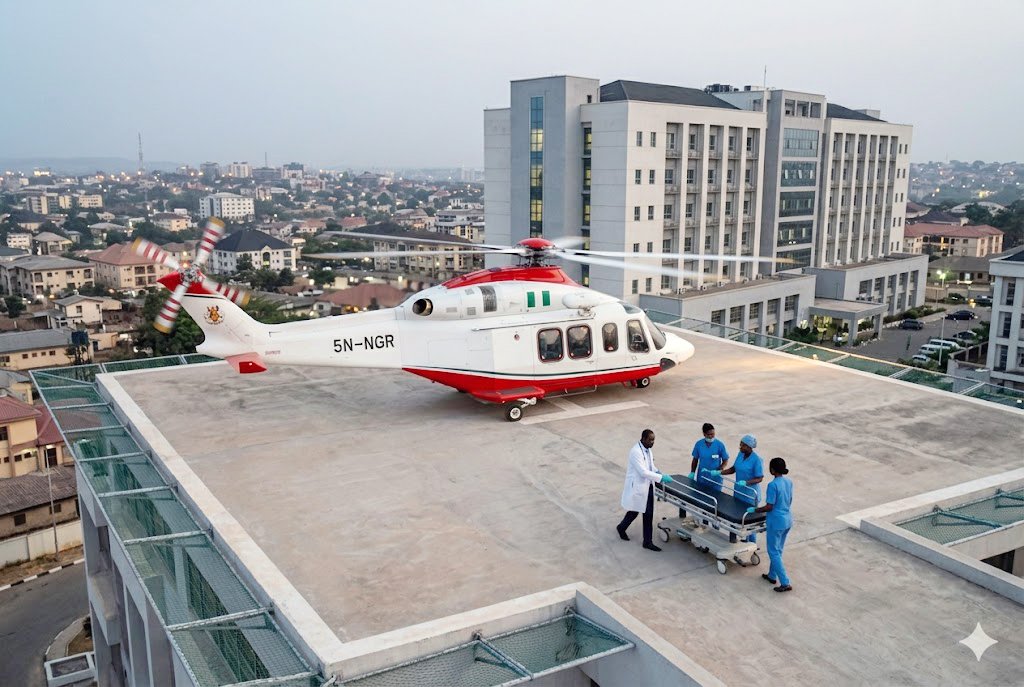
Against this backdrop, Nigeria’s renewed push toward an air emergency ambulance system represents a potentially transformative leap in emergency healthcare delivery.
Reports indicate that the Coordinating Minister of Health and Social Welfare, Professor Muhammad Ali Pate, recently explored partnership opportunities in France with Airbus, a leading aerospace manufacturer known for its aircraft, helicopters, and advanced emergency response technologies. The engagement included an inspection of an air ambulance helicopter at a government-supported emergency care facility in Lyon, signalling a serious consideration of integrating aerial medical evacuation into Nigeria’s healthcare system.
The proposed air ambulance framework is expected to significantly enhance Nigeria’s emergency response capacity, particularly for remote, inaccessible, or high-risk locations where road transport is slow, unreliable, or impossible. When integrated with existing systems such as NEMSAS and state EMS structures, air evacuation could reduce critical response times in trauma, obstetric complications, stroke, and severe accident cases—conditions where minutes often determine survival.
Similarly at the subnational level, several state governments have taken practical steps to strengthen emergency response systems through investments in ambulances, dispatch infrastructure, and trained medical personnel. These interventions are gradually reshaping the country’s emergency care architecture, even though coverage and capacity remain uneven.
A notable example is Kano State, which in March 2026 launched the Kano State Emergency Medical Services and Ambulance System (KN-SEMSAS). The initiative is designed to improve rapid response and facilitate timely transportation of patients to healthcare facilities.
According to the Commissioner for Health, Dr. Abubakar Labaran Yusuf, the system prioritises maternal emergencies, especially the safe transfer of pregnant women during labour, with transportation costs fully covered by the government. This intervention directly targets one of the leading contributors to maternal and infant mortality in the region—delayed access to skilled care.
Similarly, Kaduna State introduced the Kaduna State Emergency Medical Services and Ambulance System (KADSEMSAS) in October 2025, establishing a structured, 24-hour emergency response framework. The system integrates a dispatch centre, equipped ambulance fleet, and trained emergency medical personnel to respond to accidents, obstetric emergencies, and other acute medical conditions across both urban and rural communities.
In Anambra State, the Anambra State Emergency Medical Services and Ambulance System (ASEMSAS) has also provided a working model of state-led emergency care coordination, reinforcing the emerging pattern of decentralised but structured EMS development across Nigeria.
Notwithstanding, Nigeria’s air ambulance initiative extends beyond rapid patient evacuation; its wider significance lies in its structural reform potential within the national healthcare system. A functional air ambulance system would necessitate improvements in coordination protocols, communication infrastructure, helipad development at tertiary facilities, and strengthened referral networks between primary, secondary, and tertiary health institutions. It would also push Nigeria toward a more unified emergency command system capable of integrating air and ground response in real time.
However, the success of such a system would depend on more than procurement of aircraft. Sustainability considerations—such as operational funding, maintenance capacity, skilled aeromedical personnel, and regulatory frameworks—will determine whether the initiative becomes transformative or symbolic. Equally important is equitable access, ensuring that air evacuation does not become an urban-centric luxury service but a nationally coordinated emergency asset.
If effectively implemented, the integration of air ambulance services into Nigeria’s healthcare system could mark a decisive shift from fragmented emergency response toward a more responsive, technology-driven, and patient-centred model of care.
Nevertheless, Nigeria’s evolving emergency medical reforms reflect a growing recognition that healthcare outcomes are heavily influenced by speed of intervention. From state-level ambulance systems to the federal NEMSAS framework, and now the prospect of an air ambulance service, the country is gradually building a multi-layered emergency response architecture.
The introduction of air medical evacuation, if properly integrated and sustainably managed, could close critical geographic and infrastructural gaps that have long constrained emergency care delivery. More importantly, it would signal a shift from reactive healthcare to a more proactive, coordinated, and system-driven model.
Ultimately, the success of this reform trajectory will depend on sustained political commitment, institutional coordination, and investment in both human and logistical capacity. If these conditions are met, Nigeria’s emergency healthcare system could move from aspiration to functionality—saving thousands of lives that are currently lost to delay rather than disease.
Science & Tech
State of the Nation
As Nigeria Plans Air Ambulance Acquisition to Boost Emergency Healthcare
Related Post





Leave feedback about this