

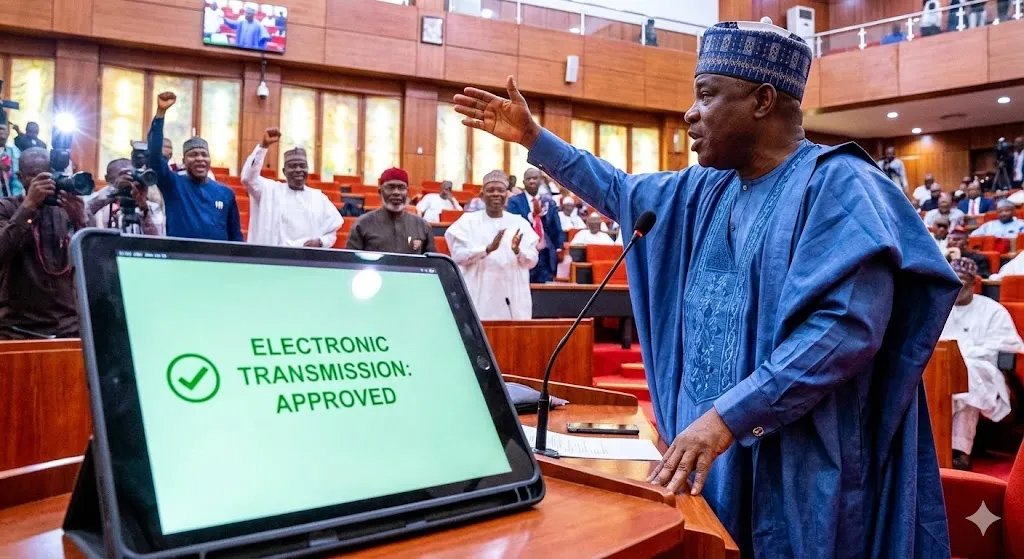
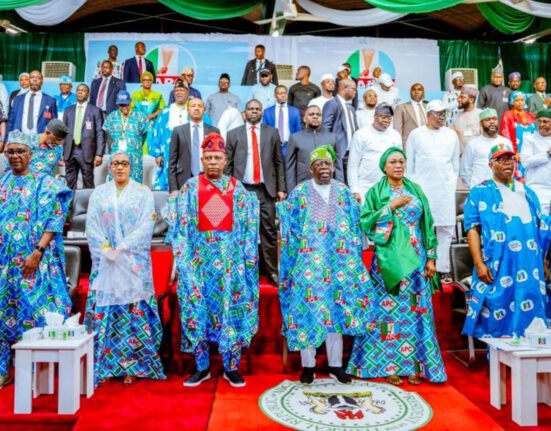
President Bola Tinubu on Wednesday, February 18th, signed the Electoral Act Amendment Bill 2026 into law, despite agitations from Nigerians over a controversial clause that makes electronic transmission of election results optional.
With the presidential assent, the bill has now become law, meaning subsequent elections in Nigeria will be conducted in line with the amended provisions.
The two chambers of the National Assembly passed the bill on Tuesday, February 17th, after months of debate and deliberations. Although the legislation contains about 154 clauses, Clause 60, which makes electronic transmission of results optional, generated the most controversy.
Initially, the House of Representatives passed a version of the bill in December mandating the electronic transmission of election results from polling units to the Independent National Electoral Commission’s Result Viewing Portal (IReV) immediately after vote counting.
The Senate, however, rejected mandatory electronic transmission and retained the provision in the 2022 Electoral Act allowing results to be transmitted to collation centres without making electronic transmission compulsory.
The Senate’s position attracted criticism from many Nigerians, who urged lawmakers to adopt the House’s earlier version.
However, the Senate re-amended its decision and resolved that electronic transmission would remain optional. The provision includes a caveat that, in the event of internet failure, Form EC8A will serve as the primary means of result collation.
On the other hand, as Nigeria prepares for another crucial electoral cycle, a pressing question dominates public discourse: Is Nigerian ready for digital transmission of election results in real time?
The debate has intensified following the introduction of electronic transmission of results by the Independent National Electoral Commission (INEC), a reform widely described as a bold step toward transparency and credibility in the country’s democratic process.
Electronic transmission of election results allows polling unit outcomes to be uploaded directly to a central server immediately after votes are counted.
In theory, this system minimizes human interference, reduces the movement of sensitive materials, and limits opportunities for tampering during collation. It promises real-time access to results, enhances public trust, and offers political parties and observers the opportunity to independently verify outcomes as they are announced.
For a nation long troubled by allegations of ballot box snatching, result manipulation, and irregularities in manual collation, digital transmission appears to be a welcome innovation. Advocates argue that it could significantly curb electoral fraud, ensure faster reporting, and align Nigeria with global best practices in electoral management.
However, beneath the optimism lies a web of concerns that cannot be ignored. Nigeria’s experience with other digital systems has not always inspired confidence. The Computer-Based Test (CBT) system used by the Joint Admissions and Matriculation Board (JAMB) provides a cautionary tale.
While CBT was introduced to eliminate examination malpractice and improve efficiency, there have been recurring complaints of technical glitches, network failures, and alleged score discrepancies. At times, candidates have questioned the authenticity of their results, citing system errors or suspected manipulation.
If similar glitches occur during an election, the consequences would be far more severe than disputed examination scores. A network failure, server crash, or technical malfunction on election day could delay uploads, distort figures, or even result in data loss.
In a highly charged political environment, such incidents could trigger public outrage, legal battles, and a deepened crisis of confidence in the democratic system. The loss or corruption of actual votes due to technical errors would be catastrophic.
Infrastructure remains one of the most significant obstacles. In many rural communities across Nigeria, electricity supply is either unstable or completely nonexistent.
Internet connectivity in remote areas is unreliable, and in some places, virtually absent. Uploading results in real time under such conditions becomes a daunting challenge. Without stable power and strong network coverage, digital transmission cannot function effectively.
Delayed uploading of results also raises concerns. If polling unit results are not transmitted immediately due to network challenges, they may need to be stored temporarily before eventual upload.
This delay creates a potential loophole that could be exploited for manipulation. Critics argue that the period between vote counting and successful upload could become a new frontier for electoral malpractice if not carefully safeguarded.
Security is another major issue. Digital systems are vulnerable to hacking, cyberattacks, and unauthorized access if not adequately protected.
The integrity of election results depends heavily on the robustness of cybersecurity measures in place. Nigerians are therefore asking whether the country possesses the technical capacity and institutional readiness to defend such a sensitive system against sophisticated threats.
Beyond infrastructure and security lies the question of preparedness. Elections are complex operations that require extensive training of personnel, voter education, and thorough system testing.
Implementing a nationwide real-time digital transmission system within a short period demands not only financial investment but also meticulous planning and simulation exercises. Any rushed deployment could expose systemic weaknesses.
The federal government, working through INEC, insists that technological innovations are essential to strengthening democracy. Yet many Nigerians remain skeptical. Can the federal government realistically achieve full operational readiness within the limited time before the next election? Or would it be safer to refine the system further before making it the backbone of the electoral process?
At the same time, sticking to the traditional manual collation system is hardly reassuring. Years of ballot box voting and physical result collation have been marred by widespread allegations of rigging, violence, and logistical chaos.
For many citizens, maintaining the status quo feels like perpetuating a flawed system that has repeatedly undermined public trust.
The real dilemma, therefore, is not whether reform is necessary — it is whether Nigeria is adequately prepared to execute this reform successfully.
Digital transmission of election results holds enormous potential to transform Nigeria’s electoral landscape. It can promote transparency, enhance accountability, and restore confidence in the democratic process.
But technology alone cannot guarantee credibility. Infrastructure gaps, technical reliability, cybersecurity, training, and contingency planning must all be addressed comprehensively.
As election day approaches, the nation stands at a crossroads. The promise of innovation must be weighed against the realities on the ground. Nigerians are not merely asking whether digital transmission is possible; they are asking whether it can be trusted.
The answer will determine not only the outcome of an election, but the future strength of Nigeria’s democracy.
State of the Nation
2027: Is Nigeria Ready For Electronic Transmission Of Election Results?
Related Post




Leave feedback about this