
Troops Recover Firearms in Mangu, Hunts Suspected Militia Leaders, Cattle Rustlers
The Nigerian Army has recovered a cache of firearms and ammunition from the residence of a suspected cattle-rustling suspect in Mwar community, Chakfem Kingdom, Mangu Local Government Area of Plateau State, as troops intensify efforts to dismantle criminal networks exploiting communal tensions to fuel violence in the area.
The recovery was made late on Wednesday, August 19, following intelligence indicating a possible attack on Mwar community by suspected armed elements.
The operation has also provided security forces with a potentially significant lead into the activities of a group of Mwaghavul militia members allegedly linked to cattle rustling and other criminal activities believed to be contributing to the cycle of attacks and reprisals in parts of Mangu.
Military sources said troops of Sector 8, Operation ENDURING PEACE, initially received intelligence about a possible attack on the community by suspected armed Fulani elements following the alleged rustling of an unconfirmed number of cattle.
Rather than treating the intelligence as an isolated communal dispute, the troops moved to investigate both the immediate security threat and the alleged criminal activity behind it.
A fighting patrol was subsequently deployed under Operation HARD KNOCK to locate the missing cattle, identify those allegedly responsible and prevent any retaliatory attack.
On reaching the area, troops deployed EIB STRATOC drones for extensive aerial surveillance of settlements, surrounding bushes and suspected cattle routes. The search, however, did not yield the missing livestock.
Further intelligence reportedly identified Pantong Stanley and other youths from the community as persons of interest in the alleged cattle-rustling operation.
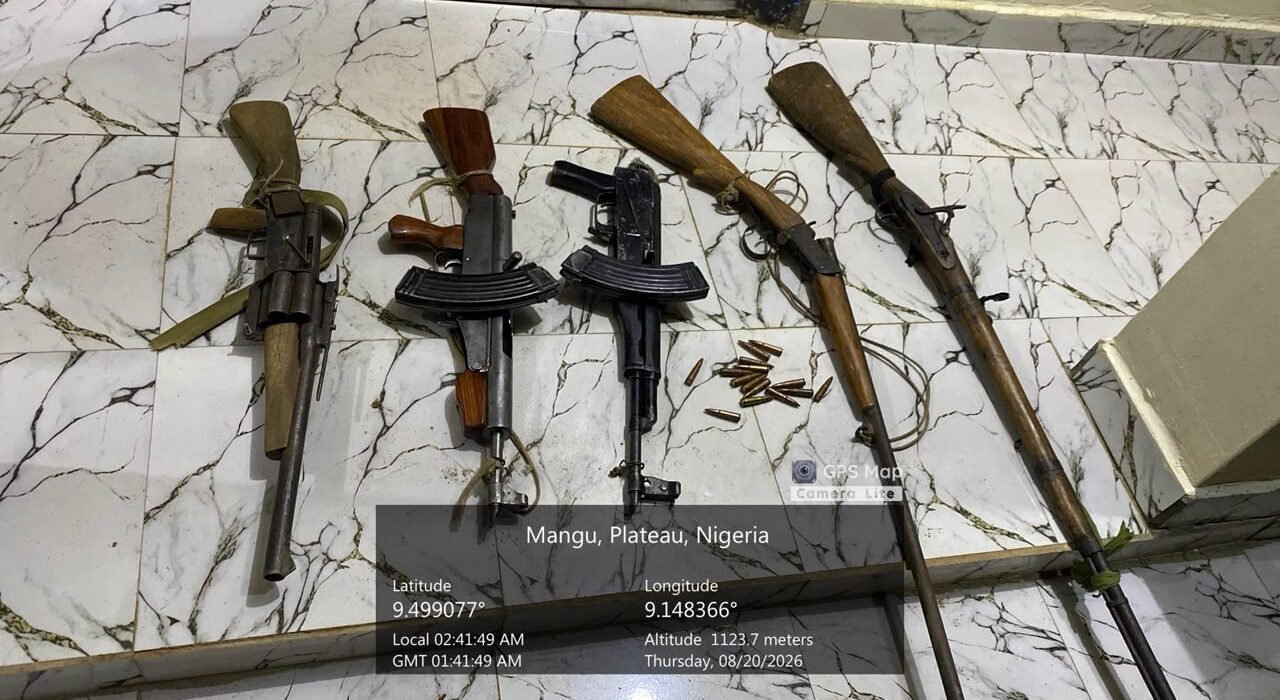
Troops subsequently located Stanley’s residence and conducted a snap raid. Although Stanley was not found at the location, soldiers recovered a significant cache of weapons and ammunition.
The recovered items comprised one AK-47 rifle, one locally fabricated AK-47 rifle, one locally fabricated revolver rifle, two Dane guns and 15 rounds of 7.62mm special ammunition.
The discovery has heightened concerns over the extent to which criminal elements may be accumulating and concealing weapons under the cover of communal grievances.
The Army is subsequently conducting further searches around the residences and locations associated with other suspects, with the aim of recovering the missing cattle and determining whether additional arms caches are concealed in the area.
The operation comes against the backdrop of a fresh escalation of violence in Mangu, where repeated attacks, reprisal killings, cattle rustling, destruction of homes and farms, and armed mobilisation have continued to deepen tensions between communities.
On August 16, an attack was reported in the Jwak Maitumbi area, where Fulani residents were allegedly attacked and several residential shelters destroyed.
Military sources said troops deployed to the area encountered extensive destruction, including about 45 shelters, as well as damage to crops and other property. The incident reportedly triggered displacement, with women, children and elderly residents fleeing the area amid fears of further attacks.
The security situation had already been fragile before the incident. Troops of Sector 8 had intervened in an armed confrontation between suspected Fulani and Mwaghavul youths in Jwak Maitumbi following reports of sustained gunfire.
Three people were reportedly killed in the confrontation, comprising two Fulani herders and one member of the local community, while another person was injured. Troops subsequently conducted clearance operations and restored calm.
Less than 48 hours after the reported attack on Fulani residents in Jwak Maitumbi, Bin-Per community in Kombun District of Mangu came under another devastating attack.
At least 23 people, including women and children, were reportedly killed in the August 18 assault, although some community sources gave a higher figure.
The attackers reportedly entered the community during the night and early hours, killing residents and destroying property before withdrawing.
However, developments following the Bin-Per attack were equally significant in understanding the subsequent military response.
Intelligence available to security forces indicated that large numbers of Mwaghavul youths had mobilised and moved into the area, where they exchanged gunfire with suspected Fulani elements.
The confrontation raised fears that the original attack could rapidly escalate into a broader communal battle. According to security information obtained by Zagazola Makama, one suspected Mwaghavul militia member was killed during the exchange of fire before troops could fully intervene, forcing the armed groups to withdraw in different directions.
The development underscored the danger of further escalation, as armed elements from opposing sides appeared to be mobilising in anticipation of additional confrontation.
Against this backdrop, the General Officer Commanding, 3 Division Nigerian Army, and Commander, Operation ENDURING PEACE, Maj.-Gen. Maxwell Dangana, moved the tactical headquarters from Jos to Mangu on August 19.
The decision was aimed at positioning the command structure closer to the epicentre of the crisis, reducing response time and enabling the commander to coordinate troops and operational assets more effectively.
The military and other security agencies are now confronting multiple, interconnected threats, including attacks on communities, possible reprisal attacks, armed mobilisation, cattle rustling, destruction of farmlands, proliferation of locally fabricated weapons and the exploitation of communal tensions by criminal groups.
The relocation of the tactical headquarters therefore provides the military command with greater capacity to coordinate intelligence gathering, surveillance, rapid response, community engagement and offensive operations from closer proximity to affected communities.
The Army has also intensified Operation HARD KNOCK to contain the violence, protect vulnerable communities, disrupt armed groups and pursue persons suspected of involvement in attacks, cattle rustling and other criminal activities.
The approach reflects a growing recognition within the security architecture that the crisis cannot be addressed solely as a series of isolated communal clashes. Increasing attention is being directed towards the criminal networks and individuals allegedly sustaining the violence.
One of the most troubling dimensions of the crisis is the possibility that criminal actors are exploiting genuine grievances between farmers and herders for personal and financial gain.
Cattle rustling, in particular, can generate substantial financial incentives for organised criminal networks while simultaneously creating conditions for revenge attacks.
The resulting cycle is complex. Livestock theft can trigger accusations against members of another community, followed by armed mobilisation and retaliatory attacks. Casualties from such attacks then become justification for further reprisals, while the original criminal act becomes obscured by competing narratives of communal victimhood.
This creates a dangerous environment in which criminal actors can exploit ethnic and communal identities to shield their activities or transform individual criminal acts into wider conflicts.
The activities allegedly associated with Pantong Stanley are therefore significant from a security perspective. The recovery of AK-pattern rifles and ammunition from a suspect’s residence reinforces the need for security agencies to distinguish between criminal actors and the wider communities in which they operate.
A similar issue has arisen in the case of Joshua Ali, a Plateau Berom youth leader reportedly arrested by troops of Sector 8 over alleged involvement in cattle rustling in Barkin Ladi.
In April 2026, security operatives in Nasarawa State reportedly intercepted 11 stolen livestock allegedly rustled by Berom militia from Bokkos in Plateau State and sold through illicit channels. The operation led to the arrest of a suspect who allegedly claimed to have purchased the animals from a Plateau paramount ruler.
Such cases, if established through investigation, underscore why security agencies must examine individual criminal responsibility rather than attribute criminal conduct collectively to entire ethnic or communal groups.
Community leaders and residents, in turn, have a responsibility to cooperate with security agencies by providing credible intelligence and refusing to shield individuals suspected of serious crimes.
Security sources have also identified several areas allegedly used to conceal or temporarily keep rustled cattle across parts of Plateau State.
In Mangu Local Government Area, the locations reportedly include Panyam, Kerang, Ampang, Manguna, Kombun and Boi, with Manguna described by security sources as particularly notorious.
In Barkin Ladi, security attention is focused on parts of Fan District, including villages and mountainous areas considered difficult to access, as well as Forong District, where the terrain and dispersed settlements may provide cover for criminal cattle-rustling networks.
In Bassa, security information points to parts of Irigwe Chiefdom and adjoining areas towards southern Kaduna, while in Riyom, suspected cattle-rustling networks are reportedly using mountainous areas and other difficult terrain to conceal or move stolen livestock.
Security authorities believe the challenging terrain and dispersed settlements in some of these locations complicate detection and recovery operations, underscoring the need for sustained intelligence-led surveillance, aerial reconnaissance and coordinated ground operations.
The central danger in Mangu is that individual criminality can rapidly become collective suspicion.
A cattle rustler may be identified as a member of a particular community, after which an attack by one group can be interpreted as an attack by an entire ethnic population. Retaliation follows, producing new victims and fresh grievances that are subsequently used to justify another round of violence.
Over time, criminals can become symbols of communal struggle, while innocent civilians are transformed into targets of revenge.
This is precisely why the Army’s intelligence-led approach is critical.
Rather than merely deploying troops after attacks occur, security agencies must identify individuals involved in supplying weapons, rustling livestock, mobilising armed youths, concealing weapons and providing safe havens for attackers.
The objective of Operation HARD KNOCK should therefore extend beyond preventing the next attack to dismantling the criminal infrastructure that makes such attacks possible.
For the operation to succeed, security forces must maintain pressure on armed groups while ensuring the protection of communities on all sides.
That requires preventing attacks on Mwaghavul communities and Fulani settlements, recovering stolen livestock, intercepting illegal firearms, identifying individuals mobilising armed youths and arresting suspects based on credible evidence.
It also requires close coordination among the Nigerian Army, Department of State Services, Nigeria Police Force, traditional institutions, youth leaders and other community stakeholders.
The security architecture must strengthen community-based intelligence systems because waiting until gunfire begins is often too late.
Mangu is now at a critical point.
The Jwak Maitumbi attack and the Bin-Per killings should not be viewed in isolation. The destruction suffered by Mwaghavul communities and Fulani residents alike requires impartial investigation and appropriate security and judicial responses.
The recovery of weapons at Mwar suggests that the military is increasingly looking beyond visible clashes to the criminal networks that may be sustaining the violence.
The challenge is to maintain that pressure while preventing legitimate community grievances from being converted into collective blame.
The way out of Mangu’s crisis is neither collective punishment nor collective revenge. It lies in evidence-based investigations, intelligence-led operations, protection of civilians, recovery of stolen property, prosecution of criminal actors and sustained engagement with communities on all sides.
Only by separating criminality from communal identity can Plateau State begin to break the cycle of violence that has repeatedly transformed individual crimes into collective conflict.