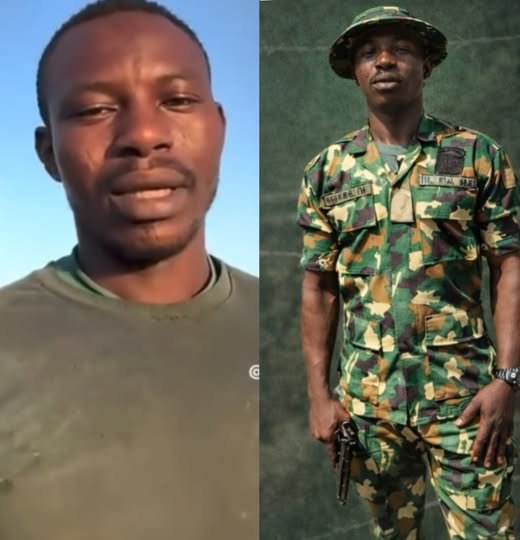
Lance Corporal Rotimi Olamilekan, the Nigerian soldier who went viral after calling on political leaders to send their children to the battlefield, has been dismissed from the Nigerian Army and is now alleging that he was subjected to months of degrading treatment, humiliation, and denial of basic rights while in detention.
Olamilekan, popularly known as “Soja Boi” (service number 18NA/77/1009 LCPL), was serving with the 81 Division Task Force Battalion in Maiduguri, Borno State, before his arrest.
In a viral video posted on his Facebook page prior to his arrest in February 2026, the soldier passionately appealed to ministers, governors, senators, members of the House of Representatives, and local government chairmen to allow their sons to enlist in the Nigerian Army—not as officers, but as rank-and-file soldiers—so they could experience firsthand the dangers troops face daily.
“The way I dey lose my colleagues, it is getting to a point where it brings tears to my eyes every day,” he said in Pidgin English. “In this country, we have 36 governors, about 109 senators, and nearly 60 ministers. We also have members of the House of Representatives and 774 local government chairmen. Let each of them send their own sons to join the Nigerian Army.”
The video, which quickly resonated with many Nigerians, went viral across social media platforms and sparked nationwide debate about the welfare of soldiers and the perceived disconnect between political elites and those fighting on the frontlines.
However, the Army took swift action. Olamilekan was arrested on February 11, 2026, following a directive reportedly issued for him to be brought to Army Headquarters in Abuja.
Allegations of Harsh Detention
In a series of media interviews following his dismissal, Olamilekan detailed what he described as a traumatic ordeal spanning over a month in detention across multiple military facilities in Maiduguri and Abuja.
According to the dismissed soldier, he was arrested at his duty post in a remote bush location in the North-East, where he had been stationed for nearly five years—more than double the standard two-year rotation timeline.
“From my location, they handcuffed my legs and hands. It was as if I had stolen or killed,” he said.
He narrated how he was transferred across several detention facilities: “From there, they moved me to Maiduguri, 70th Provost MP Guard Room. From there, they took me to Abuja SIB. I was there for more than a month,” he said. “They brought me back from Abuja to the 70th, then took me back to my location, and I was still locked up with handcuffs on my legs and hands, as if I had stolen something.”
Olamilekan claimed that during his detention in Abuja, he was kept in handcuffs on both his hands and legs for over a month, fed only twice a day with portions valued at less than N500, and denied access to his phone or any contact with his family.
“No calls. I couldn’t talk to my family or anyone. They collected my phone,” he lamented.
Multiple sources who spoke to SaharaReporters alleged that the soldier was held in unsanitary conditions and locked up in the same cell with bandits and other criminal suspects, with his hands and legs cuffed. The sources further claimed that Olamilekan’s health deteriorated due to a serious ailment while in detention, and that Army authorities allegedly refused to provide him with medical treatment despite his condition.
Olamilekan himself claimed that when he fell sick, the doctor asked if he had money. He said no, and was taken back. He later had to find a way to transfer money from outside and buy his own injections and drugs while still in detention.
He also expressed disappointment that some of the soldiers he claimed to be speaking for allegedly turned against him during the investigation. “To my surprise, the same soldiers I was speaking for were the ones investigating me and still maltreating me,” he alleged.
After being held for about a month, Olamilekan said he was formally charged without being allowed to properly defend himself. “They gave me a paper for my charges, four charges,” he said. “They called out my order and read the charges, the first, second, third, and fourth, and I was dismissed, dismissed from the regiment, just because of the video I made.”
Following his dismissal, he said he was publicly marched out of the barracks in disgrace. “It was after they dismissed me that they marched me out. I was dismissed from my unit and taken to the 7th Division. From there, they marched me out of the barracks as a dismissed soldier. It is so sad,” he said.
Olamilekan also used the opportunity to shed light on the welfare challenges soldiers face. In an interview on the Honest Bunch Podcast with human rights activist Omoyele Sowore, he stated that his last salary before dismissal was N109,000 or N111,000, which had only been increased in February 2025 from N51,000 plus a N20,000 allowance totaling N71,000.
“The suffer no be small. Apart from the salary, nothing more. Nothing dey enter for you as a soldier,” he said.
He further alleged that soldiers are forced to purchase their own uniforms and protective equipment, including bulletproof vests and helmets, with personal funds. “No, they don’t give uniform now. Ask any soldier. They buy them,” he said, estimating that a uniform costs about N55,000 and boots about N60,000. He claimed that protective equipment was typically only made available during high-profile visits.
Army’s Response
The Nigerian Army, however, has strongly refuted Olamilekan’s allegations, maintaining that his dismissal was due to persistent and grave acts of indiscipline and not his viral criticism of political leaders.
In a statement issued on April 7, 2026, by the Acting Director of Army Public Relations, Colonel Appolonia Anele, the Army clarified its position.
“The Nigerian Army categorically states that Mr. Olamilekan was not dismissed for ‘speaking the truth’ or expressing opinions on political leadership,” the statement read. “He was dismissed following persistent and grave acts of indiscipline, including violations of the Armed Forces Social Media Policy.”
The Army explained that unauthorised media appearances, commercialisation of military identity, partisan content creation, and misuse of military uniform constitute clear breaches of established regulations, and that Olamilekan’s dismissal followed due process in line with military laws.
Regarding the welfare allegations, the Army said it operates a well-structured and transparent salary system where earnings are determined by rank and years of service, as stipulated in the Manual of Financial Administration for the Armed Forces of Nigeria (MAFA).
“The claim that soldiers are required to purchase uniforms and protective equipment, including bulletproof vests and helmets, is entirely false,” the statement further revealed. “For the avoidance of doubt, no soldier is deployed to an operational theatre without the necessary protective equipment. Claims that such gear is only issued during ceremonial visits are deliberate falsehoods intended to mislead the public.”
The Army urged the public to disregard what it described as baseless allegations intended to misinform and generate unwarranted sympathy.
Public and Civil Society Reactions
The case has drawn criticism from civil society organisations, including the Rule of Law and Accountability Advocacy Centre (RULAAC), which condemned the dismissal and warned that such actions could negatively affect morale within the armed forces.
Prior to his dismissal, RULAAC had called on the Nigerian Army to immediately release the soldier, warning that silencing such voices through repression rather than engagement could damage military morale. The organisation urged the military high command to either release the soldier or ensure he is granted access to his family and legal representation.
The incident has reignited debate about the welfare of Nigerian soldiers and the perceived gap between political leadership and those fighting on the frontlines. While the military maintains strict rules on discipline and communication, many Nigerians argue that the issues raised in the video deserve attention rather than punishment.
Olamilekan has since regained his freedom and expressed appreciation to his supporters. The #FreeSojaBoi campaign on social media was largely credited with drawing attention to his case and pressuring authorities for his release. He continues to speak out about the challenges facing Nigerian soldiers and has vowed to fight for justice, stating that his dismissal was an affront to freedom of speech in Nigeria.
“I didn’t expect this. It shows that in our country, we don’t have freedom of speech, and we are not free to say the truth,” he lamented.


Leave feedback about this